Exercise
Getting back into exercise: why one miss doesn't undo a habit
A trip, a cold, a busy month, and the routine stops. Phillippa Lally's habit research on missed days, and how to plan the comeback.
1h Protocols · October 25, 2026 · 13 min read
To get back into exercise, come back small and soon. Pick the first slot after the break, do a short version of your usual session there, and count that return as a success. One missed day doesn't undo a habit. A gap that keeps growing is what goes with stopping, so the plan is for the slot after the miss.
The routine was going well. Then came a trip, a cold or a month of late nights, and when it ended, the sessions didn't come back. It feels like the habit was never real. Phillippa Lally's research says otherwise.
In 2010, Lally and colleagues at University College London asked volunteers to repeat one new daily action, such as a walk after breakfast, and to rate each day how automatic it felt. The average time to reach a plateau was 66 days. "It is sometimes frustrating when a finding, for example the statement that 'it takes 66 days to form a habit', is taken out of context," Lally told the University of Surrey in 2026. The range in the study was 18 to 254 days. "What we really showed was that how long habit formation takes is highly variable."
The same study shows what one missed day does. Below: what a miss really costs, why a long break is different, and a comeback plan you can write today.
What does one missed day do to a habit?
1. Know what one miss costs
Less than it feels like. In Lally's study, missing the occasional day "did not seriously impair the habit formation process: automaticity gains soon resumed after one missed performance," as a 2012 review by Benjamin Gardner, Lally and Jane Wardle summed it up (Gardner et al., 2012).
James Clear, author of Atomic Habits, puts the same finding in plain words in a 2017 course video: "if you miss on any given day, it doesn't actually hurt the long-term outcome" (YouTube, 3:19). That's Clear's retelling of Lally's study, and it's slightly broader than the study itself, which looked at occasional single misses, not runs of them. Nobody has tested "never miss twice" as a rule. It's sensible advice built on findings like this one.
In practice: you missed Thursday's walk, and that's all it is. The habit you're building is starting at your slot, and the next slot still feeds it.
2. Drop the 21-day clock
If you were told a habit takes 21 days, a stall at week four can feel like proof you're doing it wrong. Asked about the number on the PAN Podcast, Lally answered: "The easy part of the answer is definitely more than 21 days" (PAN Podcast, 39:44). The hard part, in Lally's answer, is that there's no single number: it depends on the action, the setting and what you count as "a habit". In that small study, "the model time ranged from 18 to 254 days" (41:16).
The 21 days came from somewhere else. Gardner and a UCL colleague traced it to a 1960 self-help book by Maxwell Maltz, a plastic surgeon who wrote that patients took about 21 days to get used to a new face. Getting used to something isn't the same as forming a habit (Gardner and Meisel, 2012). Andrew Huberman makes the same correction to millions of viewers: "it's highly variable" (Huberman Lab, 11:40 to 12:28).
Later research points the same way. A 2024 review of 20 studies (2,601 participants) found typical times of about two months, medians of 59 to 66 days, with individuals ranging from 4 to 335 days. Only four of the studies reported a time, so treat it as a rough guide (Singh et al., 2024). And in the records of 30,110 members of a North American gym chain, followed over about four years, the gym habit typically took months to form, not weeks (Buyalskaya et al., 2023).
So expect months, with a wide range.
"The easy part of the answer is definitely more than 21 days." Phillippa Lally
Why is a long break different?
3. Watch the gap, not the miss
The same gym study found what does predict stopping. Of everything the researchers measured, the strongest predictor of whether someone went to the gym on a given day was how long it had been since the last visit. For 76% of the members, the longer the gap, the less likely the next visit (Buyalskaya et al., 2023). That's a link, not proof of cause, but it matches the feeling: one missed slot is easy to come back from; three in a row feel like a decision.
Breaks are where this shows most. Katy Milkman, a behavioral scientist at Wharton, ran a trial at a US university gym in which some of the 226 students and staff could hear gripping audiobooks only while working out (the idea is covered in our short read on temptation bundling). They went more often for the first seven weeks. Then came a holiday. "It's Thanksgiving break. The gym is closed. When they come back, we look at the data and we see that the effect is completely eliminated," Milkman told Freakonomics Radio (Freakonomics Radio, 13:52). The authors note that earlier gym studies found the same: habits fade over time, and fastest over holiday breaks (Milkman et al., 2014).
A comeback that isn't planned waits for a good day. In a field study of 120 students and staff at UC Berkeley, people expected to go to the gym two to five times more often than they did once the study's rewards ended (Acland and Levy, 2015). "I'll get back to it when things settle down" leans on exactly that forecast.
4. Make the first session back smaller, not bigger
After a gap, three moves feel responsible and tend to backfire.
The first is doubling up: you missed two sessions, so the next one has to be twice as long. A bigger session is a bigger reason to skip it. US guidance also links the risk of getting hurt to the size of the jump from your usual level of activity (Physical Activity Guidelines for Americans), and after weeks off your usual level has dropped.
The second is waiting for Monday, or January. A fresh date can help when your next slot is far away, but each day of waiting adds to the gap.
The third is blaming yourself. In studies by Silverman and Barasch, people whose log showed a broken run of days did less afterwards, especially when they blamed themselves for the break (Silverman and Barasch, 2023). A day counter that resets to zero works against you here.
The CDC's advice for older adults says it plainly: after a break for illness or travel, "start again at a lower level and slowly work back up to your usual level of activity" (CDC). It's written for people over 65, and it's a sound rule after any long break.
Plan the comeback before the break
5. Write your comeback day now
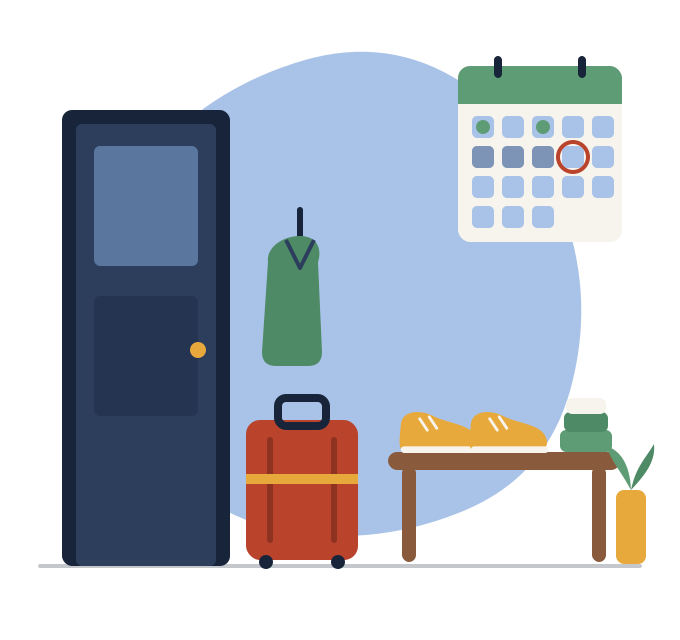
The best time to plan a comeback is before you need one. Look at the next two months and name the break most likely to hit: a trip, a busy spell at work, a cold going round the house. Write the break in your calendar, and on the day after it write "comeback: short version". If your weeks are irregular, make it the first slot after the break instead of a date.
That turns "when things settle down" into a plan, with nothing to decide when you're out of the rhythm. Your short version is small enough for a bad day: ten minutes of what you usually do, at a pace where you can talk. During the break, keep something tiny going, or rest.
6. Plan skips into your week
A week with no slack turns one missed session into a broken plan. Build the slack in. In a four-week study of daily step goals with 273 students and staff, people whose goal included two planned skip days a week met their goal on more days than people with no slack, and they got going again more often the day after a miss (Sharif and Shu, 2021). It was one study, in young people, with step goals, so take it as a direction. Plan four sessions as "four, with one or two skips", and a skipped day becomes a choice you made.
7. Count the comeback as the win
The session after a miss is the one to tick, even if it's your shortest of the month. In a megastudy of 61,293 members of a US gym chain, researchers tested 54 four-week programs to get people to the gym more often. The best performer paid a tiny bonus, worth US$0.09, for returning after a missed workout (Milkman et al., 2021). The authors say they probably overstate the top results, and most effects faded once the four weeks ended. You don't need a prize. Ticking the comeback costs nothing.
Before you start again
If you haven't exercised for a while, the NHS suggests speaking to your GP first. WHO and US guidance say that for light to moderate activity, like brisk walking, that's generally not needed (NHS; WHO). If checking would put your mind at rest, do.
Some situations call for a doctor before you start again: chest pain, pressure or fainting when you're active; a pounding, skipping or racing heart, dizziness or unusual breathlessness when you're active; a heart, kidney or metabolic condition, or another long-term condition or symptoms you're unsure about; a doctor has told you to limit activity; or recent surgery, a heart event, an injury or an illness. Check with a doctor first, then come back to your plan. If you're pregnant or recently gave birth, agree your choices with your midwife or doctor. With a cold or fever, wait until you're better, then start at your first slot after that.
Once you're going, stop if anything hurts or you feel unwell, and if new symptoms show up as you do more, talk to a doctor. A missed session on its own needs none of this, only the next slot.
Back to the break
The routine that stopped after a trip was a habit still forming, hit at its weakest point, with nothing set up to restart it. One miss doesn't undo the work; a long gap after it is what goes with stopping. So plan the comeback: write the day, keep it small, and count it. As Lally told the University of Surrey, "how long habit formation takes is highly variable." Coming back is how you stay in the range.
To build this around your own week, try the 1h Protocol to Build an Exercise Routine, a program of practical education. Its free first chapter starts with a quick check, asks how your last try went and how it ended, and finds your pattern: the Big Plan, the Floating Slot, the Long Gap, the Chore, the Wrong Room or the Tune-up. For the Long Gap, your first step is writing your comeback day before the next break. The full program takes about an hour, over seven chapters. You leave with up to three changes to start now, each with an alternative, your own line for the slot after a miss, a log that counts the week with planned skips, your slots in your calendar, and reviews on days 7, 14 and 30. Four one-tap check-ins follow by email on days 1, 7, 14 and 30, if you're signed in. Start free
See also how to make exercise a habit, the best time to work out and do short workouts count?
Frequently asked questions
How do I get back into exercise after a long break?
Come back at a short version of your usual session, at talking pace, in the first slot you can name, and build up over the following weeks. The CDC's advice for older adults is to "start again at a lower level and slowly work back up" after illness or travel (CDC). If you've been off for a long time, see the doctor list above first.
Does missing one workout ruin a habit?
No. In Lally's habit study, missing the occasional day didn't seriously set the habit back, and gains soon resumed after a single miss (Gardner et al., 2012). What predicts stopping is the gap that opens after a miss (Buyalskaya et al., 2023), so the next slot matters more than the missed one.
Should I make up a missed workout?
Not by doubling the next one. A bigger session is harder to start, and a jump above your usual level raises the risk of getting hurt (US guidelines). Do your normal or short version at the next slot; if you planned skips, the miss may already be one.
Does it really take 21 days to form a habit?
No. A 2024 review found typical times of about two months, ranging from 4 days to almost a year (Singh et al., 2024). The 21 days traces back to a 1960 book about adjusting to plastic surgery (Gardner and Meisel, 2012).
How do I come back after being ill?
With a cold or fever, wait until you're better, then start at your next slot with your short version. After a more serious illness, an injury, surgery or a heart event, check with a doctor first, then come back to your plan, lower than where you left off (CDC).
Sources
This article draws on Dr Phillippa Lally's interview on the PAN Podcast and with the University of Surrey, Katy Milkman's interview on Freakonomics Radio, videos by James Clear and Andrew Huberman, and the studies and guidance listed below.
- Habits and Health, with Dr Phillippa Lally (podcast episode, PAN Podcast #6, 2021)
- Does it really take 66 days to form a habit? We asked the expert, Dr Pippa Lally (University of Surrey interview, 2026)
- When Willpower Isn't Enough (replay), with Katy Milkman (podcast episode, Freakonomics Radio, 2015)
- James Clear, How long does it take to form a new habit? (course video, 2017)
- The science of making and breaking habits (podcast episode, Huberman Lab, 2022)
- Gardner, Lally and Wardle, Making health habitual (narrative review restating a study of 96 volunteers, 2012)
- Singh et al, Time to form a habit (systematic review and meta-analysis, 20 studies, 2,601 participants, 2024)
- Gardner and Meisel, Busting the 21 days habit formation myth (researchers' blog, UCL, 2012)
- Buyalskaya et al, Habit formation in gym attendance and hospital handwashing (machine-learning study, 30,110 gym members over about four years, 2023)
- Milkman, Minson and Volpp, Temptation bundling at the gym (randomized field experiment, 226 students, faculty and staff at one US university, 2014)
- Acland and Levy, Habit formation in gym attendance after incentives end (field experiment, 120 students and staff at UC Berkeley, 2015)
- Silverman and Barasch, How broken streaks affect consumer decisions (field and experimental studies, 2023)
- Sharif and Shu, Emergency reserves and persistence after failure (five studies; Study 1, 273 students and staff over four weeks, 2021)
- Milkman et al, A megastudy of 54 gym-attendance programs (megastudy, 61,293 members of a US gym chain, 2021)
- US HHS, Physical Activity Guidelines for Americans, 2nd edition (government guideline, 2018)
- CDC, Older adults: adding physical activity (health information page, 2025)
- NHS, Physical activity guidelines for adults aged 19 to 64 (health information page, 2024)
- WHO, Guidelines on physical activity and sedentary behaviour (guideline, 2020)