Drinking
Alcohol cravings: Judson Brewer's way to ride out an urge
How to handle alcohol cravings: name the urge, find it in your body, watch it peak and fall, and decide the first drink before the evening starts.
1h Protocols · October 17, 2026 · 13 min read
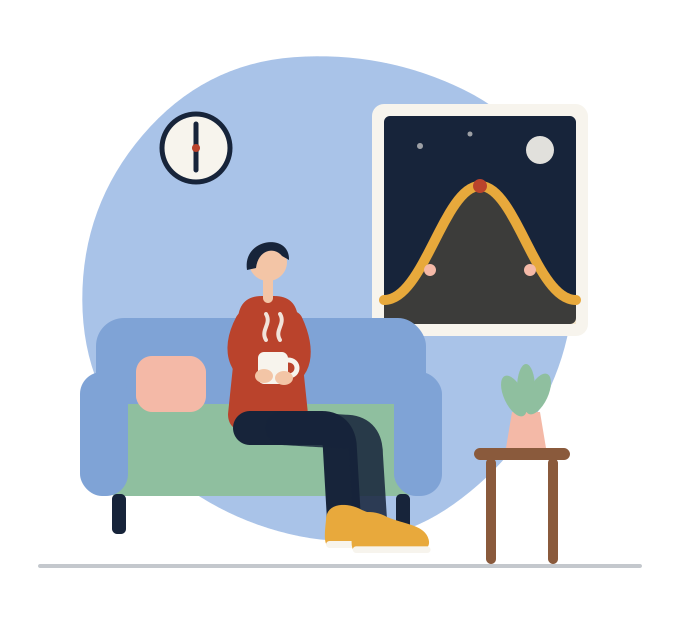
To handle an alcohol craving, treat it as something that passes rather than an order. Name it ("this is an urge"), find where you feel it, rate it from 0 to 10, and watch it for a few minutes while it peaks and falls before you decide anything. Then ask what you want right now. And since the first drink makes the next one harder to turn down, decide about it before the evening starts.
One day a patient walked into Brewer's office and said: "Hey, Doc, my head's going to explode if I don't smoke." Brewer improvised. He went to the whiteboard and asked the man to describe what "head exploding" felt like and how intense it was. Heat, burning, tightness, tension. Brewer drew an arrow as the intensity climbed, peaked and started to come down. "I've always smoked before the craving got this intense," the man said. "But here it went down and I didn't smoke a cigarette" (Hidden Brain, 35:00 to 35:59).
Brewer is a psychiatrist and neuroscientist who has treated people with addictions, first at a veterans' hospital in Connecticut, and has run trials of mindfulness training, mostly for smoking and eating. His TEDMED talk on breaking habits has more than 24 million views on ted.com. He also founded MindSciences, a company that sells app-based mindfulness programs and merged with Sharecare in 2020 (TED). His examples are cigarettes and food, not alcohol, so each step below is paired with what studies of drinkers found. You'll learn what a craving is made of, how to ride one out, and how to make the first drink a decision.
Why fighting a craving keeps it going
1. Know what a craving is made of
The US National Institute on Alcohol Abuse and Alcoholism (NIAAA) describes an urge or craving as "a broad range of thoughts, physical sensations, or emotions that tempt you to drink, even though you have at least some desire not to" (NIAAA).
What sets it off is usually the setting. In a review of 237 studies of alcohol and other drugs, 79 of them on alcohol, cues and cravings predicted later use, and across all the drugs the link was strongest on the same day (Vafaie & Kober, 2022). That's a link over time, not proof that the cue caused the drink. Feelings act as cues too. In a review of 41 lab experiments with 2,403 people, those put in a bad mood wanted and drank a little more alcohol than after a neutral task, though studies of everyday life found a less clear link (Bresin et al., 2018).
So the craving usually has a time and a place: 6 p.m. at the kitchen counter, the walk past the shop, the end of a hard call. Our guide to drinking every night covers how the setting starts the drink.
2. Notice what avoiding, distracting and gritting your teeth do
Brewer describes the standard answers to a craving and their limits (15:21 to 17:24). Avoiding "people, places, and things" can help in some situations, but the cues for a daily habit are everywhere. Distraction helps for a while, but "it's always lingering in the background." As for willpower, his efforts to help patients resist were failing "pretty much every day," he says (18:06).
He also describes what happened when it gave way. People who had resisted for a long time found "that first cigarette or that first drink just opened the floodgates," and then guilt and shame fed more of the same (17:24). Psychologists call this the abstinence violation effect.
Some avoidance is still worth keeping: NIAAA suggests keeping little or no alcohol at home while urges are strong. Brewer's point is narrower. An urge you can only run from or wrestle with keeps its hold.
Ride out the urge, step by step
The middle of Brewer's approach is the whiteboard moment: stay with the urge, describe it, and see what it does. You don't have to make the craving go away before you can say no.
3. Name it
Rachel Hart, a coach who helps people change their drinking (she sells a coaching program), starts here. "One of my first things really is just naming that you're having an urge," she told Mel Robbins. "Oh, this is an urge. Of course, I'm having an urge. It's five o'clock" (The Mel Robbins Podcast, 25:07). For her, control isn't deleting every urge. "Controlling to me is my ability to manage and influence what's going to happen next" (24:26).
Brewer's patient did it out loud. Naming his thoughts and sensations, Brewer says, helped him "see them for what they were" (36:22).
4. Find it in your body and give it a number
Where is it? A tight chest, restless hands, a dry mouth. Brewer describes cravings as "simply made up of body sensations," with "tightness," "tension" and "restlessness" that "come and go" (TED, 6:23). Then rate it from 0 to 10. A number turns a vague want into something you can watch change.
5. Watch it rise and fall for a few minutes
Don't push it down, and don't act on it yet. NIAAA's version: "Instead of fighting an urge, accept it as normal and temporary. As you ride it out, keep in mind that it will soon crest like an ocean wave and pass." Researchers call this urge surfing.
The best alcohol test comes from University College London. In a double-blind experiment, 68 at-risk drinkers aged 18 to 50, most of them students, heard one short recorded session (Kamboj et al., 2017). Half learned to notice their urges, locate them in the body and let them be without acting; the other half learned to relax the urge away. Both were asked to practice at home for a week. Relaxing seemed to lower craving a little more in the moment, a borderline result. Yet over the following week, the noticing group cut its drinking by about 9 UK units, against about 3 for the relaxation group.
It's one small study with a one-week follow-up and self-reported drinking, so treat it as a skill worth trying, not a guarantee. A snapshot study of 50 US students points the same way: those who accepted their present experience more showed a weaker link between an automatic pull toward alcohol and hazardous drinking (Ostafin & Marlatt, 2008). The bigger programs have a ceiling. Across 9 trials with 901 adults in treatment for alcohol or drug problems, mindfulness relapse-prevention programs, usually eight weekly group sessions, did no better on relapse than other treatments, and their effect on craving was small (Grant et al., 2017).
So keep it modest: a few minutes, eyes open. If watching the feeling stirs up more distress than it settles, stop and do something else. Changing your drinking can stir up low mood or worry for a while. If it feels like too much, see your doctor.
6. Ask what you want right now
Brewer's first step is mapping the habit loop: what came just before the reach? With his patients in a binge-eating group, the question was "Am I hungry or am I X, Y, or Z? You know, lonely, bored, angry, frustrated, you know, sleepy" (39:49 to 40:28). For a drink, the honest answer is often relief, quiet, company or permission to be off the clock. Once the job is named, do it another way first: food, a shower, ten minutes outside.
One step of Brewer's method stays with smoking: he had smokers pay close attention while smoking. We don't carry that over to alcohol.
Plan for the first drink
7. Decide before the cue, because the first drink changes the next decision
In lab studies with social drinkers, a small first dose, about one or two drinks for an adult of average weight, made people want more, and a bit more than that made it harder to hold back (Field et al., 2010). Even belief played a part: when 32 drinkers without dependence were given a drink they thought contained alcohol, their craving rose and they found it harder to hold back on a reaction task (Christiansen et al., 2016). These are lab tasks, and "harder to refuse" isn't the same as unable: the decision simply costs more after the first drink.
Anna Lembke, a psychiatrist at Stanford, pictures pleasure and pain as a balance. After the lift, the brain pushes back past level, and on a small scale that rebound is "that moment of craving," wanting one more (The Diary of a CEO, 19:03). She calls the balance "a metaphor" and "an oversimplification" (16:26).
So make the decision while the brake is fully on. Pick your number, or a drink-free evening, in the morning or before you get home. In a study of 100 heavy drinkers near Liverpool who wanted to cut down, the number they planned each morning went closely with what they drank that day (Jones et al., 2018). That's a link, not proof that planning cuts drinking. If you have a first drink and want a second, give it about half an hour: in one small lab study of 15 social drinkers, the wish for more peaked about thirty minutes after a larger first drink (Rose & Duka, 2006). Treat that as a starting point.
If an evening goes further than you meant, mark it, notice what got in the way, and make the next day a normal plan day. In Brewer's account, the guilt after a slip feeds the next one.
Back at the whiteboard
Brewer's patient didn't win by force. He watched a feeling he had always obeyed, and it came down on its own. The alcohol research says something similar, cautiously: wanting a drink and having one can come apart. Brewer's own summary of the practice is "notice the urge, get curious, feel the joy of letting go and repeat" (TED, 8:54).
For more, see our guides to how to drink less, hangxiety and whether alcohol-free drinks help, and alcohol and sleep for the nightcap. If a plan isn't enough, talk to a doctor or a local alcohol service.
To build this around your own evenings, try the 1h Protocol to Reduce Your Drinking. Its first chapter is free: a few questions about your week, your real drink and why you drink, plus a short check on how your body reacts when you drink less, find your pattern and give you a first step. The full program is practical education and takes about an hour. It walks one evening with you, from the plan to the next morning, and helps you write a first-drink line for the moment your urge usually comes. You choose to drink less, take a break or stop, and leave with a page built from your answers, a moment card for your lock screen and a fourteen-day sheet. Short check-ins follow on days 1, 7, 14 and 30, and the day-7 review asks the body question again. Start free
Frequently asked questions
What does a craving for alcohol feel like?
A mix of thoughts ("I deserve one"), body sensations such as tightness or restlessness, and feelings like stress or boredom that tempt you to drink "even though you have at least some desire not to," in NIAAA's words. That's why it feels like a pull in two directions (NIAAA).
How long does a craving last?
There's no reliable number. NIAAA calls urges short-lived. Give one a few minutes of watching, or ten minutes doing something else, before you decide.
How do I stop a craving without giving in?
You don't have to make it stop. Name it, find it in your body, rate it, watch it peak and fall, then do what you actually want first. In one small UK experiment, this kind of noticing went with less drinking the following week than relaxing (Kamboj et al., 2017).
Why can't I stop after one drink?
After a drink or two, the next one is easier to want and harder to refuse: in lab studies, a small first dose raised the wish for more (Field et al., 2010). So the decision that counts is the first one, made before the cue.
Are there medicines for cravings?
That's a question for a doctor, who knows your health and your other medicines; we don't give advice on medicines either way. If cravings keep breaking your plan, talk to a doctor or a local alcohol service.
Sources
This article draws on Judson Brewer's interview on Hidden Brain and his TEDMED talk, Rachel Hart's interview on The Mel Robbins Podcast, Anna Lembke's interview on The Diary of a CEO, US and UK public guidance, and the studies listed below.
- The Curious Science of Cravings (podcast episode with Judson Brewer, Hidden Brain, 2024)
- Judson Brewer, A simple way to break a bad habit (talk, TEDMED, 2015)
- Change Your Relationship With Alcohol, with Rachel Hart (podcast episode, The Mel Robbins Podcast, 2023)
- The Dopamine Expert, with Anna Lembke (podcast episode, The Diary of a CEO, 2025)
- NIAAA, Rethinking Drinking: Alcohol and your health (public self-help website, US)
- NICE, Alcohol-use disorders: diagnosis and management of physical complications (CG100) (clinical guideline, UK, 2010, updated 2017)
- Kamboj et al, Ultra-brief mindfulness training reduces alcohol consumption in at-risk drinkers (randomized double-blind experiment, 68 UK adults, 2017)
- Ostafin & Marlatt, Surfing the urge (cross-sectional study, 50 students, abstract only, 2008)
- Grant et al, Mindfulness-based relapse prevention for substance use disorders (systematic review and meta-analysis, 9 trials, 2017)
- Vafaie & Kober, Association of drug cues and craving with drug use and relapse (systematic review and meta-analysis, 237 studies, 2022)
- Bresin, Mekawi & Verona, The effect of laboratory manipulations of negative affect on alcohol craving and use (meta-analysis of 41 lab experiments, 2018)
- Field et al, Acute alcohol effects on inhibitory control and implicit cognition (narrative review of lab studies, 2010)
- Christiansen, Jennings & Rose, Anticipated effects of alcohol stimulate craving and impair inhibitory control (placebo lab experiment, 32 drinkers, abstract only, 2016)
- Rose & Duka, Effects of dose and time on the ability of alcohol to prime social drinkers (lab experiment, 15 social drinkers, abstract only, 2006)
- Jones et al, Do daily fluctuations in inhibitory control predict alcohol consumption? (ecological momentary assessment study, 100 UK heavy drinkers, 2018)