Procrastination
Implementation intentions: the if-then plan that helps you start
Implementation intentions are if-then plans that tie a task to a cue you set in advance. What the research shows, with examples and a WOOP template to try.
1h Protocols · October 4, 2026 · 11 min read
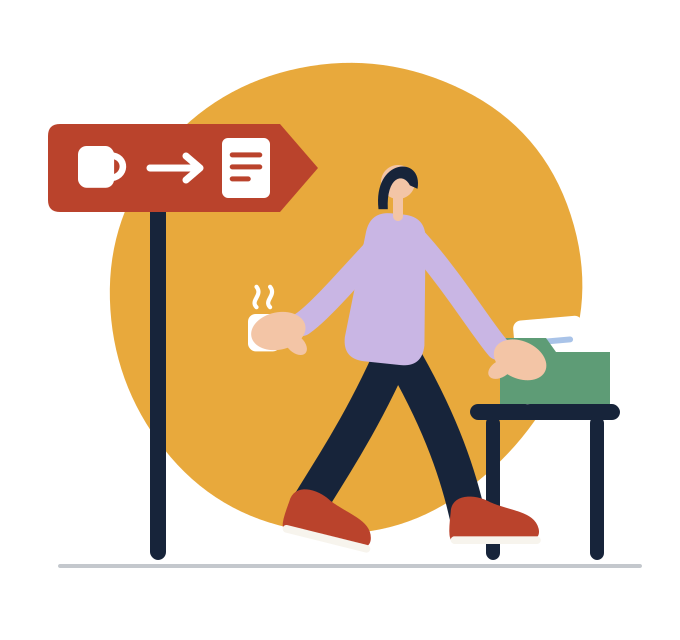
Implementation intentions are if-then plans that link a situation to an action you've chosen in advance, such as "If it's 9 a.m. and I'm at my desk, then I'll open the tax return and fill in the first page." The psychologist Peter Gollwitzer proposed them as a second step after setting a goal (Gollwitzer & Sheeran, 2006). A to-do list entry such as "do my taxes this week" says what you want; the if-then plan adds when, where and how, which is the part most to-do lists leave out. For procrastination, that matters because the decision to start gets made before the moment when you least feel like starting.
The procrastination researcher Tim Pychyl uses one for a habit he kept skipping. He brushed his teeth twice a day without fail but flossed only sometimes, because a broad plan to floss at night left him room to decide he didn't feel like it. So he tied flossing to an exact cue, which runs roughly: if there's toothpaste on my toothbrush, then I put the brush down and pick up the floss (iProcrastinate).
How to write implementation intentions
Everyday plans tend to fail on detail, Gollwitzer and Sheeran warn. "Tomorrow" in the if-part and "eat healthily" in the then-part leave you deciding on the spot, barely better than the goal itself, and a plan can name a moment that rarely comes or an action you can't do (Gollwitzer & Sheeran, 2006). A good one takes four steps.
- Pick one task and its next action. Name the task you keep putting off, then the first physical move, such as opening the file or calling the supplier.
- Choose a precise "if." Use a time and place ("at 9 a.m. at my desk"), a routine you never skip ("when my first coffee is poured"), or a feeling ("when I feel the urge to check my phone"). Pychyl's toothpaste works because it happens every night and can't be mistaken.
- Choose a short "then." The WOOP pages ask for an action that is "short, concrete, and to the point" (WOOP). The researchers in a 2026 trial counted a plan like "I will try to focus more" as too abstract, and gave "If I feel distracted, then I will move to the library" as a concrete one (Zhou et al., 2026).
- Run three checks. Gollwitzer and Sheeran say a plan helps when it is precise, viable and instrumental (Gollwitzer & Sheeran, 2006):
- Precise: could you picture the exact moment, with nothing left to decide then?
- Viable: will that moment really happen this week, and can you do the action when it does?
- Instrumental: does the action move the task forward?
Then add a second plan for your most likely escape. Pychyl describes four studies in which people who planned in advance how to handle temptations stayed on track better, over and above how motivated they were (iProcrastinate).
The 1h Protocol to Stop Procrastinating writes your start plan in the same if-then form, filled in from your own answers about when and where you work.
Why if-then plans work
Gollwitzer and Sheeran's review points to three things the plan does.
- It moves the decision earlier. Pychyl calls an implementation intention "a form of pre-decision" (iProcrastinate). You commit in advance to act when the situation arrives, so the reluctant moment has less to decide.
- It makes the cue easier to notice. In the pooled studies, people who made if-then plans were better at detecting, attending to and remembering the cues they had picked (Gollwitzer & Sheeran, 2006).
- It makes the response easier to start. Actions tied to a cue started faster, took less mental effort and didn't need a fresh decision. Gollwitzer describes if-then plans as creating "instant habits" (Gollwitzer & Sheeran, 2006).
Implementation intention examples for four common problems
Pychyl's episode walks through four problems in pursuing a goal, taken from a chapter by Frank Wieber and Gollwitzer, and each has its own kind of plan.
| Problem | What it looks like | Example plan | From |
|---|---|---|---|
| Getting started | The task waits for a better moment | "And if it is Saturday morning at 10 a.m., then I will sit down at my computer and make an outline for my essay!" | Gollwitzer & Sheeran |
| Staying on track | A friend, a notification, a sudden errand | When I begin my homework, I shut the door and turn off social media | Pychyl |
| Changing tactics | Pushing on with a method that isn't working | "And if I receive disappointing feedback, then I will switch to a different strategy!" | Gollwitzer & Sheeran |
| Running on empty | Too tired at the end of the day | If the kids are in bed, I immediately put on my workout clothes and go to the treadmill | Pychyl |
The "if" can also be an internal cue, such as a strong feeling (Gollwitzer & Sheeran, 2006). That suits procrastination, where the trigger is often the moment a task starts to feel bad, as our article on why we procrastinate explains. One student in a recent trial wrote: "If I feel overwhelmed by the workload, then I will break the task into smaller parts" (Zhou et al., 2026).
Do if-then plans really work?
On average, yes. Gollwitzer and Sheeran pooled 94 tests and found that forming an if-then plan helped people reach their goals more often than holding the goal alone, a medium-to-large effect by psychologists' standards. Plans helped people remember to act, seize good moments and get past initial reluctance. Most of the tests were with university students, though, and the goals ranged from lab tasks to health habits, so the evidence is about following through in general (Gollwitzer & Sheeran, 2006).
One experiment measured procrastination directly. Shane Owens and colleagues asked university students to come in for an experiment, and half of them formed a plan for when and where they would go. Those with a plan were much more likely to turn up. Heavy procrastinators turned up less often overall, but the plan seemed to help them about as much as everyone else (Owens et al., 2008). It was one simple, scheduled task.
Outside the lab, effects shrink. A review of self-control strategies reports that planning prompts in reminder letters raised flu vaccination by 4 percentage points, while in one large field experiment, planning prompts for gym visits made no difference over the following two weeks; its authors call for more research on long-term benefits (Duckworth et al., 2018). The method has also been tested on putting off bed, which our article on revenge bedtime procrastination covers.
Pychyl calls if-then plans very effective but not a panacea, and admits he still sometimes decides that one night won't make or break his gums (iProcrastinate).
What is WOOP?
WOOP is psychologist Gabriele Oettingen's four-step version of mental contrasting with implementation intentions: Wish, Outcome, Obstacle, Plan. You name a wish that is challenging but doable, imagine the best outcome, find the main obstacle inside you, and write an if-then plan for it. The WOOP site says you need only a few minutes, "but you need to be focused and stick to the right order of the four steps" (WOOP).
Oettingen's research suggests why the obstacle step matters. In her studies, people who indulged in positive fantasies about a goal did less to reach it: graduate students who daydreamed more about landing a job reported sending fewer applications and getting fewer offers, and students who fantasized more about their grades studied less and scored lower (Rethinking Positive Thinking). The studies were correlational, but the pattern kept repeating.
"Dreamers are not often doers."
Gabriele Oettingen, Rethinking Positive Thinking
The WOOP pages ask you to find an obstacle inside you, such as an emotion, a belief or a habit, by asking what lies behind the first obstacle you name. A review by Angela Duckworth and colleagues reports that the combination supports self-control better than either mental contrasting or if-then planning alone (Duckworth et al., 2018). In a 2026 trial with first-year students in China who procrastinated, one written WOOP session led to more days of starting their task over the following week than positive thinking alone, though it was a small, short trial at a single university (Zhou et al., 2026).
Here's what that looks like in practice, for a tax return you've been avoiding:
- Wish: file the tax return by the end of the month.
- Outcome: the relief of it being done, and no more dread every time you see the folder.
- Obstacle: when I open the forms, I feel I don't know where to start, so I check email instead.
- Plan: if I open the forms and feel stuck, then I'll fill in the parts I already know and list the documents I'm missing.
Back to the toothbrush
Pychyl's flossing plan works because the cue arrives every night and leaves nothing to decide. Yours can work the same way: pick the moment in advance, make the action small enough for that moment, and plan for the feeling that usually wins. As Pychyl admits about his own gums, it won't stop every skipped night, but on average it helps people follow through more often.
"When we perform mental contrasting, we gain energy to take action."
Gabriele Oettingen, Rethinking Positive Thinking
Write tomorrow's plan tonight, before the reluctant moment comes. If you're not sure what your "if" should be, the free part of the 1h Protocol to Stop Procrastinating finds the pattern behind your delay and gives you one first step to build the plan around.
Frequently asked questions
What are implementation intentions?
Implementation intentions are if-then plans that link a specific situation to a specific action, so you decide in advance when, where and how you'll act. Peter Gollwitzer proposed them as a second step after setting a goal, and a meta-analysis of 94 tests found they helped people reach goals more often than intending alone (Gollwitzer & Sheeran, 2006).
What is an example of an implementation intention?
Gollwitzer and Sheeran give this one: "And if it is Saturday morning at 10 a.m., then I will sit down at my computer and make an outline for my essay!" (Gollwitzer & Sheeran, 2006). The "if" can also be a feeling: "If I feel overwhelmed, then I'll break the task into smaller parts."
Do if-then plans really work?
In research, they usually help: across 94 tests, mostly with students, they had a medium-to-large effect on reaching goals compared with intending alone (Gollwitzer & Sheeran, 2006). Field studies show smaller effects, and long-term results are less clear.
What is WOOP?
WOOP is a four-step exercise developed by psychologist Gabriele Oettingen: Wish, Outcome, Obstacle, Plan. You picture the best outcome of a wish, find the inner obstacle in the way and write an if-then plan for it. In a 2026 trial with Chinese students who procrastinated, one written session led to more days of starting their task than positive thinking alone (Zhou et al., 2026).
How do I write an implementation intention?
Pick one task and its next concrete action, choose a specific cue (a time and place, a routine or a feeling), and write "If [cue], then I will [action]." Check that the cue will happen and the action is doable and useful. Then add a second plan for your most likely distraction.
Sources
This article draws on Gollwitzer and Sheeran's meta-analysis, Oettingen's book and WOOP materials, recent trials, and Pychyl's iProcrastinate podcast.
- Gollwitzer & Sheeran, Implementation intentions and goal achievement: a meta-analysis of effects and processes (meta-analysis of 94 tests, 2006)
- iProcrastinate podcast, Tim Pychyl: Implementation intentions as a solution to 4 problems in our goal pursuit (podcast episode, 2010)
- Owens, Bowman & Dill, Overcoming procrastination: the effect of implementation intentions (experiment with university students, 2008)
- Zhou et al., A randomized trial of mental contrasting with implementation intentions to curb academic procrastination (randomised trial, 2026)
- WOOP my life, Practice and science pages (developer's method pages, undated)
- Gabriele Oettingen, Rethinking positive thinking (book, publisher page and excerpt, 2015 paperback)
- Duckworth, Milkman & Laibson, Beyond willpower: strategies for reducing failures of self-control (integrative review, 2018)