Procrastination
Revenge bedtime procrastination: why you stay up and how to stop
Revenge bedtime procrastination is staying up late to win back time the day took. Why it happens, what it costs, and how researchers suggest you stop.
1h Protocols · October 4, 2026 · 11 min read
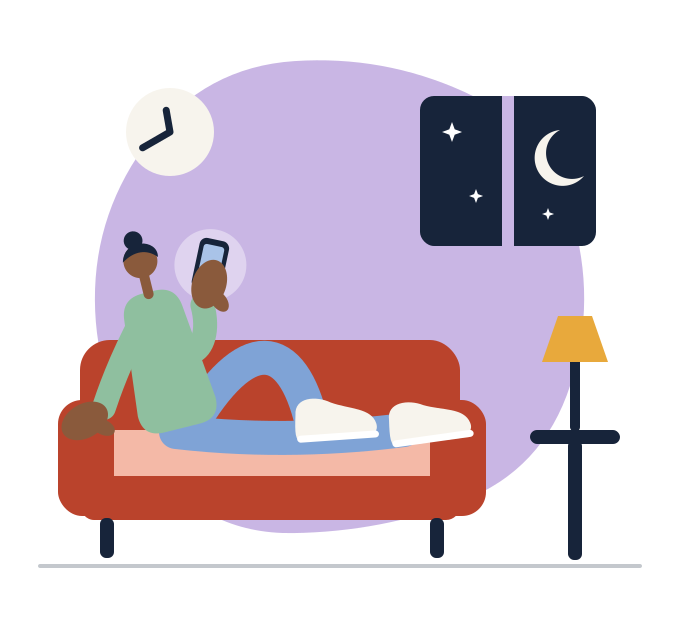
Revenge bedtime procrastination is staying up later than you planned, when nothing is keeping you up, because the late evening is the first time all day that feels like your own. Most people who do it know they'll be tired tomorrow. What they don't want is to end the only free hours they had, and by then willpower is running low. So the approach researchers suggest keeps those hours and gives them a set ending.
Vanessa Hill came to the problem through the YouTube comments on her science videos: when one listed the standard sleep advice, viewers replied that nobody could do all that, and she noticed how much of it "really relies on self-control and discipline and willpower," as she told the Ologies podcast. That question took her into a PhD on bedtime procrastination at CQUniversity in Australia, with a 2022 review of 43 studies, interviews and a trial. Along the way she "started feeling kind of bad about telling people" to stop, because her interviews showed how much the late hours meant to them.
Why do I procrastinate going to sleep?
Researchers call it bedtime procrastination. A 2014 Utrecht University study led by Floor Kroese, which named the behavior and gave researchers a scale to measure it, defined it as "failing to go to bed at the intended time, while no external circumstances prevent a person from doing so." A baby, a night shift or an on-call phone doesn't count. In the team's online survey of adults, people who put things off during the day tended to put off bed too.
The researchers noticed something odd. Procrastination usually means putting off something unpleasant, and going to bed isn't unpleasant. Their guess:
"It is not so much a matter of not wanting to sleep, but rather of not wanting to quit other activities." (Kroese and colleagues, 2014)
The "revenge" in the popular name is about why people don't want to quit. Mel Robbins, on her podcast, describes an evening of scrolling after a stressful day as "getting back at your job because it stressed you out." Hill heard versions of that in her interviews, many of them with people in their first jobs after university. Four reasons kept coming up:
- They wanted me time. Entry-level jobs gave them little say over their work, and the night was when they had some agency. Hill sees the same theme in new parents and in people caring for relatives.
- They wanted room for their own interests, such as a sudden 10 pm question about how the pyramids were built.
- They were enjoying the wind-down too much to end it. "They put off going to bed because they're enjoying winding down," Hill says.
- They didn't want tomorrow to start. Researchers call this tomorrow aversion: not wanting today to end, because then the next day begins.
Procrastination researcher Fuschia Sirois adds an emotional reason: her group's work suggests that people who stay up often distract themselves instead of thinking through an argument or a hard moment from the day, the same short-term mood repair that why do I procrastinate? explains for daytime delay.
Why stopping is harder at night
Kroese's team pointed out that the decision to go to bed comes at the end of the day, when self-control is typically weaker, so they expected strategies that don't depend on willpower to work best. Hill puts it more bluntly: in the evening we rely on habit "a lot more" than at any other time of day, and when you're sleepy, small tasks feel like more effort. Her review found that people who put off bed more tended to find evening routines, such as brushing their teeth or planning the next workday, unpleasant.
So the person deciding whether to get off the sofa at 11:40 pm is the most tired version of you, running mostly on habit, and a plan that needs that version to choose sleep by force asks a lot.
Is bedtime procrastination bad for you?
It can be, mostly because of the sleep it costs. Hill's review found moderate links between putting off bed and shorter sleep, poorer sleep quality and more daytime tiredness, along with more stress, anxiety and low mood. Most of the studies were one-off surveys, and more than half were of university students, so the review rated the evidence as low certainty and can't say which comes first. Adults need seven or more hours of sleep on a regular basis, according to the American Academy of Sleep Medicine and the Sleep Research Society, and regularly getting less is linked with poorer performance, more errors and accidents.
Most delays are smaller than people fear. In two diary studies with people who had signed up to cut their bedtime procrastination, Hill found about half were delaying bed by 30 minutes or less a night. Long delays and bedtimes that swing by hours worry her; 20 minutes on your phone, in her view, isn't a crisis. Harvard Health Publishing agrees that occasional bedtime procrastination is a normal part of life and unlikely to affect your health.
The guilt doesn't help either. Many of Hill's participants felt guilty using their phone before bed; in her view, that shame affects sleep, and adults needn't feel guilty about screen time that helps them wind down.
Bedtime procrastination happens before you get into bed. If you go to bed on time and still lie awake, or poor sleep has lasted for months or makes daily life hard to cope with, the NHS advises seeing a doctor, and a persistent low mood that comes with the late nights is worth raising at the same appointment.
How to stop revenge bedtime procrastination
The obvious fix is to move the me time earlier in the day. Hill tested it. In a trial of her program, her team helped people find time for themselves during lunch breaks, commutes and straight after dinner. "It did not work," she says. People needed to wind down at night, when it's dark and quiet. The five steps below keep the evening and give it a shape.
1. Log one week before you change anything
Eric Zhou of Harvard Medical School points out that most of us can't remember when we meant to go to bed versus when we did. He suggests writing both down for a week or two. Hill's habit approach adds two more notes, the cue that started the late night and the reward you got from it, because at midnight willpower "probably won't work."
The evening log asks four questions a night:
- What time did I mean to be in bed?
- What time did I get there?
- What started the delay? (A time of day, a feeling such as dread about tomorrow, a place such as the sofa.)
- What did I get from it? (A laugh, a niche interest, quiet, time with nobody needing me.)
If the log shows the sofa is the cue, Hill suggests, stop sitting on it at night, and spend ten minutes at the dining table or 20 minutes reading in bed instead.
2. Pick a bedtime you can keep
If you need to be in bed by 11 but usually get there at 1, Zhou says, aiming for 11 straight away probably isn't realistic. He suggests moving bedtime earlier by 15 or 30 minutes, and building from there. Set the target by counting back from the time you have to get up, leaving room for seven or more hours. If you want your whole night rebuilt around your own times, that's the job of the 1h Protocol for Better Sleep.
3. Keep the me time, and give it an ending
Hill's approach is what behavior scientists call substitution: keep the reward, and switch to an activity with a built-in end. If scrolling on the sofa is how you unwind, she suggests a 30-minute episode in bed with the TV's sleep timer on. People worry it's still a screen in bed, she says, but you can stop an episode, and you can't stop the scroll. Sirois says the same about reading to calm down: that's fine "if you set a limit on it."
4. Move the stopping point outside your head
Build the stopping point into the room, so the tired version of you doesn't have to decide. Hill suggests smart lights set to go out at 11:30 every night, as your cue to get up and get changed. Zhou adds a social cue: share your aim and your actual bedtimes with someone. He counts a promise to another person among the most powerful tools you have.
5. Write one if-then plan for your weakest moment
Kroese's team suggested if-then plans for bedtime because they need little mental effort. Timothy Valshtein, Gabriele Oettingen and Peter Gollwitzer tested the idea in two randomised trials with university students, who wrote down a wish, its best outcome, their inner obstacle and a plan such as "If it is 11:00pm, then I will stop with whatever I am involved with and get ready for bed!" The gap between planned and actual bedtime narrowed, but mostly because students chose more realistic bedtimes, and they didn't sleep more. So use the plan for two jobs: settling on a bedtime you'll keep, and getting through the moment you usually slip. We explain how to write one in implementation intentions.
A plan for the most tired version of you
Hill went into research because the usual sleep advice relied on willpower, and few people have much of it at 11:40 pm. The plan above asks for very little: a bedtime you can keep, a wind-down that ends on its own, a cue in the room and one if-then plan. It also leaves your evening in place. Hill has cited a 1993 Seinfeld routine about "night guy," who stays up late and leaves the five hours' sleep to "morning guy," and her research has made her reluctant to fire him.
"A lot of things that people do at night to help them wind down are forms of rest, but they're not sleep." (Vanessa Hill)
If late nights are part of a wider habit of putting things off, the 1h Protocol to Stop Procrastinating takes about an hour and ends with a personal protocol built from your answers, followed by four short check-ins over 30 days. Give tonight an ending: set the cue before you sit down, then start the free part, which finds what's in the way and gives you one first step.
Frequently asked questions
What is revenge bedtime procrastination?
It's going to bed later than you intended when nothing is stopping you, usually to claim time for yourself after a day that left none. Researchers call it bedtime procrastination, a term introduced in a 2014 Utrecht University study. "Revenge" is the popular label for the motive.
Why do I stay up late when I'm tired?
Staying up gives you something the day didn't: time that's yours, room for your interests, a wind-down or a delay before tomorrow. By late evening people rely more on habit than on self-control, and sleepiness makes even small routines feel like more effort.
Is bedtime procrastination bad for you?
It can be. In a 2022 review of 43 studies, it went with shorter, poorer sleep and more daytime tiredness, though most studies were one-off surveys that can't prove cause. Occasional late nights are normal; delaying bed by hours on most nights eats into the seven or more hours adults need.
How do I stop revenge bedtime procrastination?
Keep your evening and give it a set end. Log planned and actual bedtimes for a week, move bedtime earlier by 15 or 30 minutes at a time, swap open-ended scrolling for something that finishes on its own, and use a cue such as lights going off at a fixed time.
Is bedtime procrastination the same as not being able to sleep?
No. Bedtime procrastination is staying up when you could go to bed. If you go to bed on time and still lie awake, or poor sleep has lasted months or makes daily life hard to cope with, the NHS advises seeing a doctor.
Sources
This article draws on Vanessa Hill's interview on Ologies and her 2022 review, Floor Kroese's 2014 study, and the trials and guidance below.
- Bedtime procrastination: introducing a new area of procrastination (Kroese, de Ridder, Evers and Adriaanse; online survey, Frontiers in Psychology, 2014)
- Go to bed! A systematic review and meta-analysis of bedtime procrastination correlates and sleep outcomes (Hill and colleagues; meta-analysis, Sleep Medicine Reviews, 2022)
- Using mental contrasting with implementation intentions to reduce bedtime procrastination: two randomised trials (Valshtein, Oettingen and Gollwitzer; randomised trials, Psychology & Health, 2020)
- Noctohabitology (sleep procrastination) with Dr. Vanessa Hill (Ologies podcast episode, 2026)
- Don't want to go to bed? Dealing with bedtime procrastination (Eric Zhou, Harvard Health Publishing, 2022)
- How to stop procrastinating with Dr. Fuschia Sirois (Your Parenting Mojo podcast, episode 170, 2022)
- The only way to stop procrastinating (The Mel Robbins Podcast, episode 42, 2023)
- Recommended amount of sleep for a healthy adult (American Academy of Sleep Medicine and Sleep Research Society, joint consensus statement, 2015)
- Insomnia (NHS, patient guidance, reviewed 2024)