Stress
No time for yourself? Why the basics go first on heavy days
On heavy days sleep, meals, movement and friends get cut first, just when they matter most. Why it happens, and how to protect the smallest version of one.
1h Protocols · October 30, 2026 · 12 min read
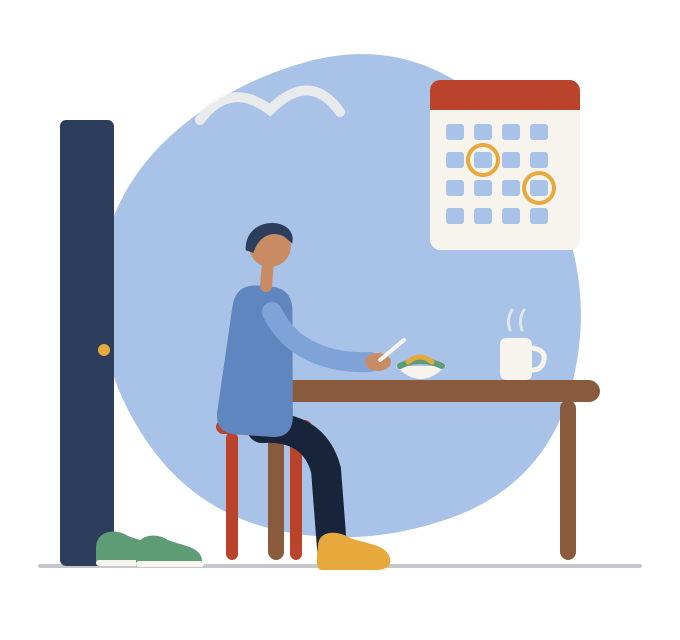
If you have no time for yourself, start smaller than you think. On heavy days the basics go first, and a squeezed base makes every next demand feel heavier. So pick the one basic you tend to drop first, shrink it to a version that survives your worst week, and put it in your calendar on your two heaviest days before the week begins.
"For most people in everyday life, you have an overscheduled life, a million competing priorities, and often you put yourself last on that list," says Dr Aditi Nerurkar, a physician and lecturer at Harvard Medical School, on The Mel Robbins Podcast (43:03). She has written a book on stress, The 5 Resets, which she talks about on the show; we mention it so you know, not as a recommendation. Her point in that minute: whatever helps has to fit an ordinary, crowded day.
A word on scope before the steps, since this article touches sleep and meals. It is about everyday stress from the load of work, home and caring. In the words of the 1h Protocol to Manage Everyday Stress: "This is a wellness program about everyday stress from the load you carry at work, at home and in caring for others, not health care. It doesn't give medical advice, and it doesn't diagnose or treat anything. It isn't for burnout, anxiety disorders, depression or trauma." If stress doesn't ease, or it starts getting in the way of your daily life, or what you're trying yourself isn't helping, see a doctor.
Below, Nerurkar's point is joined with the work of Sabine Sonnentag, a work psychologist who studies recovery, Ashley Whillans's writing on time, and public guidance from the World Health Organization. The steps and their order are ours; each idea is credited.
Why the basics go first
1. The heavy days are the ones that cut recovery
You'd expect people to rest more after a hard day. Research finds the opposite. In a 2018 review, Sonnentag called it the recovery paradox: "When people experience a high level of job stressors, they tend to detach less from their jobs during nonwork time, ... they engage less in physical activity ..., and their sleep quality is impaired" (Sonnentag, 2018). These are links found across many studies, not proof that one causes the other. But the picture is consistent: the days that most call for recovery are the days it is least likely to happen.
It feels sensible in the moment. Something has to give, and the basics look like the parts that can wait. The gym can be skipped. Lunch can happen at the desk, or not at all. The call to a friend can wait until things calm down, which can mean months. Sleep gives up an hour to the inbox.
2. It's energy that runs out, more than time
The obvious fix is to find more time. Whillans, a researcher who studies time and happiness, writes about "time poverty", the feeling of never having enough time, and notes that "a major source of time poverty is tight work deadlines" (Harvard Business Review, 2019). The feeling is real. But for the basics, time may not be what's missing.
In a diary study, 78 police employees reported on five working days. On days with more hassles at work (missing information, failing equipment, broken communication), they had less energy to get themselves going afterwards, spent less time on sport and more on low-effort activities. Long hours didn't explain it, and neither did simply being tired. As the authors put it, "time scarcity is not an appropriate explanation for a low amount of time spent on sport activities" (Sonnentag & Jelden, 2009). It was one occupation, over one week, so treat it as a direction rather than a rule.
The practical lesson: a plan that needs energy at the end of a bad day tends to fail on exactly that day. The authors suggest, without having tested it, moving the effort to a point before the energy is gone, such as a run in the morning instead of the evening, or packing the sports bag in the morning so starting takes less.
3. A short night makes small demands feel bigger
Sleep is the basic that's easiest to trim and the one that changes the next day most. In a lab study of 53 healthy adults across two experiments, people kept awake for one night felt more stressed and more angry than rested people after easy, low-pressure tasks. Hard tasks stressed both groups about equally. The authors' reading: losing sleep "lowers the psychological threshold for the perception of stress" (Minkel et al., 2012). That was a full night without sleep in a lab, so ordinary short nights may do less. The direction is still worth knowing: after a bad night, the small things land harder.
It seems to run the other way too. A 2021 review pooled trials that set out to improve sleep in different ways. Where sleep got better, stress eased a little too, across six comparisons that measured it (Scott et al., 2021). That's a reason to protect sleep on heavy days. It isn't a rule about how many hours you need, and nothing here sets one.
4. Movement is often the first thing dropped
A review of 55 studies that followed people over time found that in about three in four of them (76.4%), stress went with less physical activity afterwards (Stults-Kolehmainen & Sinha, 2014). These are links, and the studies measured things in different ways. One finding in the same review is more hopeful: people who already moved by habit tended to keep it up under stress. That suggests the habit matters more than the effort on any one day, which leads straight to the steps below.
Protect the smallest version
5. Pick the basic you drop first
Look back at your last heavy week. Which of the four went first: sleep, a proper meal, moving, or time with people? Most people have an answer straight away. That's the one to protect. Trying to guard all four at once is one more demand on a full week.
In the 1h Protocol to Manage Everyday Stress, this is one of five patterns of how a day tips. It's called the Squeezed Basics, and it belongs to the Refill, the part of the load that's about breaks, an end to the day and the basics. The other patterns are about the Load (too much open at once) and the Hands (whose demands they are, and who shares them).
6. Shrink it until it survives a bad week
Then decide the smallest version you'd keep even on your worst day. A ten-minute walk. A sit-down lunch away from the screen. Your usual lights-out, kept. One call or one message to someone you like. If you work changing hours, "lights-out" becomes your usual time for your main sleep, and "lunch" becomes a sit-down meal.
Small is the point. It's the size that still happens when energy has run out, which is the day it counts. These sizes are a starting point, not a finding: no trial has tested a ten-minute walk against a twenty-minute one for this. Pick what you'd honestly keep, and grow it later if you like.
7. Book it on your two heaviest days, before the week starts
The weak spot is deadline week. The basic is the first thing cut because it feels like the only thing that can give. So make the decision before the week begins, when you still have the energy to make it. Look at the coming week, find your two heaviest days, and put the small version in your calendar on both, like any other appointment.
The World Health Organization's advice on stress points the same way: "Set time for regular meals, time with family members, exercise, daily chores and other recreational activities" (WHO). A set time takes the choice out of the moment, when you're least able to make it.
If your evenings are the problem, the end of the day needs its own fix. Our guide on how to relax after work covers giving your day an end point, so sleep isn't the last thing left standing. For sleep itself, see how to sleep better. For movement in small doses, see do short workouts count. If food is where stress shows up, see emotional eating.
8. Keep one person in the week
People are the basic that's easiest to put off. "When things calm down" keeps moving. The WHO advises staying in touch: "Keep in touch with family and friends and share your concerns and feelings with people you trust. Connecting with others can lift our mood and help us feel less stressed" (WHO).
So keep one person in your week, for a call, a walk or a meal. Talk about anything but the to-do list. It doesn't need to be long. If you're caring for someone and time with others has vanished, see caregiver stress.
Why looking after yourself isn't the whole fix
You may have been told the answer is more self-care: a bath, a massage, an app. Nerurkar tells a story from early in her own life: a doctor told her to "go get a massage and just relax", and it didn't work for her (The Mel Robbins Podcast, 55:23).
A large survey points the same way. It covered 46,336 workers at 233 UK employers that chose to take part, in 2017 and 2018. Those who had joined relaxation classes, time management courses, well-being apps, sleep apps or sleep events were no better off than those who hadn't (Fleming, 2024). It was a snapshot, not a trial, so it can't show these things never help. But it fits what Sonnentag concludes: supporting recovery "is always only the second-best option", and "it is crucial to keep job stressors within certain limits" (Sonnentag, 2018).
That's why protecting a basic is one move among three. The others work on the load itself. If too much is open at once, see feeling overwhelmed. If others set what lands on you, see how to say no at work. If it all sits with you at home, see mental load. For the whole picture, start with how to manage stress.
Back to your list
Putting yourself last is a choice that keeps getting made for you, one heavy day at a time. Hard days drain the energy the basics need, and a squeezed base makes the next demand land harder. What fits a crowded week is small and decided early. Pick the basic you drop first, and put its smallest version in your calendar today.
To build this around your own days, try the 1h Protocol to Manage Everyday Stress, a program of practical education. Its free first chapter asks a few short questions to find your stress pattern, shows the Load, the Hands and the Refill in one screen, and gives you one first step for your pattern. The full program takes about an hour: you put your real load on one page and sort it, walk one loaded day through to its end, raise what isn't yours, and write one line for the moment it all lands at once. You leave with a plan built from your own answers, a fourteen-day log to try it, and reviews on days 7, 14 and 30 in your calendar. Short check-ins follow by email on days 1, 7, 14 and 30. It's for adults 18 and over. Start free
Frequently asked questions
Why do I stop exercising when I'm stressed?
Most people do. In a review of 55 studies that followed people over time, about three in four found that stress went with less physical activity (Stults-Kolehmainen & Sinha, 2014). A diary study of police employees found that after hassle-filled days, energy to get started was what was missing, more than time (Sonnentag & Jelden, 2009). Keep the movement small, and decide it before the day.
Does a bad night make stress worse?
It can make small things feel bigger. In a lab study, healthy adults kept awake for one night felt more stressed after easy tasks than rested people did (Minkel et al., 2012). Protect your usual lights-out on heavy days. There's no number of hours to hit here.
How do I make time for myself when I'm this busy?
Make the basic small enough that time isn't the issue, then book it before the week starts on your two heaviest days. A ten-minute walk, a sit-down lunch or one call to a friend fits into weeks where an hour never will.
What's the smallest version that still counts?
The one you'd keep on your worst day. For sleep, that might be your usual lights-out; for meals, a sit-down lunch; for movement, a ten-minute walk; for people, one call or message. The size is a starting point. Grow it once it's steady.
Is self-care enough to fix stress?
Rarely on its own. In a survey of over 46,000 UK workers, those who used relaxation classes, apps or sleep programs were no better off on average (Fleming, 2024). Looking after the basics matters, but the load matters more. Sort what's open, raise what isn't yours, and give the day an end. If stress doesn't ease, or it starts getting in the way of your daily life, or what you're trying yourself isn't helping, see a doctor.
Sources
This article draws on Dr Aditi Nerurkar's conversation on The Mel Robbins Podcast, Ashley Whillans's article in Harvard Business Review, Sabine Sonnentag's research on recovery, and the studies and guidance listed below.
- Mel Robbins with Dr Aditi Nerurkar, 5 tools to protect your brain from stress, Ep 176 (podcast episode, official transcript, 2024)
- Ashley Whillans, Time for happiness (magazine article, Harvard Business Review, 2019)
- Sonnentag & Jelden, Job stressors and the pursuit of sport activities (diary study of 78 police employees, 2009)
- Sonnentag, The recovery paradox (review, 2018)
- Stults-Kolehmainen & Sinha, The effects of stress on physical activity and exercise (systematic review, 2014)
- Minkel et al, Sleep deprivation and stressors (two lab experiments, 53 healthy adults, 2012)
- Scott et al, Improving sleep quality leads to better mental health (meta-analysis of trials, 2021)
- Fleming, Individual-level workplace wellbeing interventions (cross-sectional survey of UK workers, 2024)
- World Health Organization, Stress: questions and answers (public health page, 2026)
- World Health Organization, Doing What Matters in Times of Stress (illustrated self-help guide, 2020)