Procrastination
Perfectionism and procrastination: it's the fear, not the bar
Perfectionism and procrastination are linked through fear of falling short, not high standards. What the research shows, and five ways to start anyway.
1h Protocols · October 4, 2026 · 10 min read
If you put off work because it has to be perfect, your high standards probably aren't what's stopping you. The link between perfectionism and procrastination runs through fear: in a review of 44 studies, people with high personal standards procrastinated slightly less, while worry about mistakes, about being judged and about never being good enough went with more delay. So you can keep your standards and work on how you handle the gap between the work in front of you and the work you imagine.
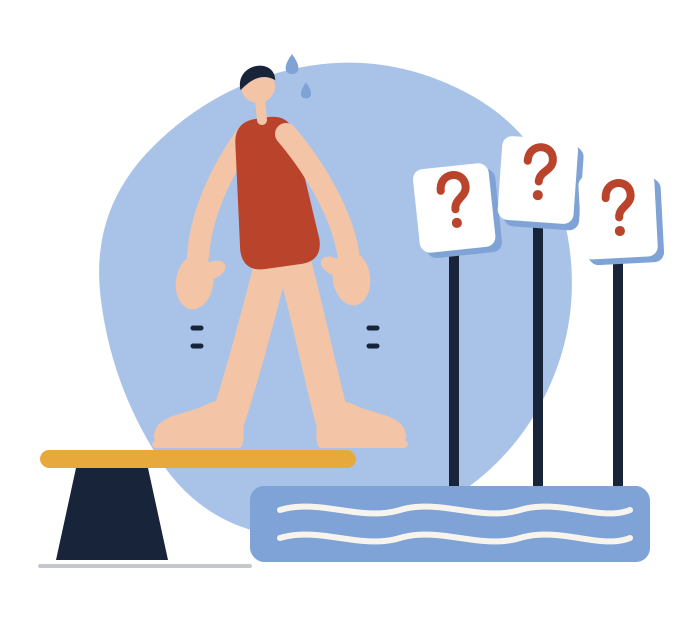
Adam Grant, now an organisational psychologist at Wharton, met that gap on a diving board at 14. He would walk to the end of the board, stop and back up again, sometimes for 45 minutes or an hour, because whenever an approach felt off balance he had decided a perfect dive was already out of reach, so why bother trying? On Ten Percent Happier, he separates two kinds of perfectionism: very high standards with a positive picture of what you're reaching for, and fear of failure, the sense that everyone is about to find out you're flawed.
Does perfectionism cause procrastination?
It depends which part of perfectionism you mean. Researchers split it in two: perfectionistic strivings, setting very high standards for yourself and pushing to meet them, and perfectionistic concerns, meaning harsh self-criticism, worry about how others will judge you and never feeling satisfied, even after a success. An earlier review, from 2007, measured perfectionism as a single trait and found almost no link with procrastination. When the procrastination researcher Fuschia Sirois and her colleagues separated the two parts in 2017, concerns went with more procrastination and strivings with slightly less, and both links held after they accounted for the overlap between the two. These are correlations from surveys: they show what travels together, not what causes what.
How to stop procrastinating as a perfectionist
All five steps keep your standards. They change how you handle the gap between the standard and the first draft.
1. Find out which voice is talking
Before the task you're avoiding, ask yourself four questions:
- Am I thinking about the work, or about what people will think of it?
- If I hit the standard, would I be satisfied, or would I find the next flaw?
- Is this standard mine, or one I feel others have set?
- Do I expect I can reach it?
The first half of each question sounds like striving; the second half sounds like concern. Sirois notes that the two are only modestly related, so you may hear both (iProcrastinate). The 1h Protocol to Stop Procrastinating starts in a similar place: its free part looks for the obstacle behind your delay, and one of the patterns it looks for is the worry that the work won't be good enough.
2. Set your target score before you start
Grant's turning point came when his coach told him there's no such thing as a perfect 10 in diving. "A 10 is not for perfection. It's for excellence," Grant says: judges can give a flawed dive a 10. Now he starts each project by choosing its target score. A book, which takes two years of his work life, gets a nine. An Instagram post gets a six and a half, he told The Diary of a CEO.
Public guidance says the same in plainer words. Hong Kong's Department of Health tells students to strive for "good enough" rather than perfection: "Done is better than perfect." Here's what that looks like in practice: before you open the file, write one line, "Good enough for this draft means...", and give it a score out of 10.
3. Time-box a rough first version
A clinical self-help workbook on perfectionism, from Western Australia, suggests putting a time limit on the work and stopping at that point, "however much or little I've accomplished." Washington University in St. Louis puts it this way: "It's better to be a perfectionist editor than a perfectionist creator." Grant's advice on WorkLife is the same idea: don't criticize your work while you're creating it.
4. Test the fear like an experiment
The workbook turns the fear into a prediction you can check. Write down what you expect to happen and how sure you are, from 0 to 100%. Plan a small test, do it, and record what happened and how much of the prediction came true. In its worked example, the owner of a car repair shop, who had avoided his paperwork for a year, was 90% sure it would overwhelm him and reveal a huge tax bill. After four Saturday mornings he rated the prediction 10% true.
Thomas Curran, a psychologist at the London School of Economics, uses a lighter version on Hidden Brain: write the "I must" thought down, rate on a scale of one to 10 how realistic it is, and ask what would happen if you didn't do it right now. Grant goes further and keeps a failure budget of three projects a year that are allowed to fail. If nothing fails, he reasons, he isn't stretching.
5. Answer a miss with one kind line
The fear feeds on self-criticism, so how you respond to a slip matters. Sirois's review suggests self-compassion as a way to ease the self-judgment that perfectionistic concerns and procrastination share, and in one experiment, students who were told not to be too hard on themselves after failing a test studied longer for the retest. Our article on procrastination guilt and self-compassion covers what to do after a slip.
How do perfectionism and procrastination feed each other?
Sirois explains the link through expectations. People high in concerns often have the same goals as people high in strivings, she told Tim Pychyl on his iProcrastinate podcast. The difference shows up before any effort, when you ask yourself whether you'll succeed. If the honest answer is "probably not," stepping back or putting it off feels like the sensible move. People high in strivings expect to reach their standards, and that confidence carries them through.
The same pattern shows up among the heaviest procrastinators. In a survey of Swedish university students, those with severe procrastination worried much more about falling short than the rest, while their personal standards barely differed.
Curran describes perfectionism as less about pursuing success than about avoiding failure. On Hidden Brain, he described a lab experiment run by his colleague Andrew Hill. People on a cycling task were given a distance to cover, told afterwards that they had failed, whatever they had done, and asked to go again. People low in perfectionism kept up their effort. People high in it held back on the second try. "It doesn't just look like complete withdrawal, by the way," Curran said. "It can also come in the form of procrastination."
"A lot of procrastination is driven by fear." (Adam Grant)
From there the delay keeps itself going. Putting the task off brings instant relief, the rushed work or missed chance at the deadline seems to confirm the fear, and, as Sirois's review describes, the self-criticism feeds back into itself and makes the next task feel riskier; why do I procrastinate? explains that relief loop in full. The perfectionism workbook calls avoiding tasks "the other side of the same coin" as checking and redoing: some perfectionists put a task off indefinitely, others leave it to the last minute.
Margaret Atwood told Grant on WorkLife that she put off starting The Handmaid's Tale for about three years and tried to write "a more normal novel" instead, because the idea seemed "too batty." Her worry was the classic one: "You don't know whether they'll like it or not." Her advice for a first draft is short: "The wastepaper basket is your friend."
If perfectionism comes with a persistent low mood or worry you can't switch off, see a doctor; habit planning like this doesn't replace one.
Start with the task you fear
"The task you're putting off isn't always the one you hate. It might be the one you fear." (Adam Grant)
Look down your list for that task. High standards, as Curran puts it, "really don't have to come with insecurity," so keep yours and change the start. If the worry that it won't be good enough is what stops you, the free part of the 1h Protocol to Stop Procrastinating finds the obstacle in your way and gives you a first step; give that step a target score before you begin.
Frequently asked questions
Does perfectionism cause procrastination?
Its fearful side goes with more procrastination; its striving side doesn't. In a 2017 review of 44 studies, perfectionistic concerns (worry about mistakes and judgment) were linked with more procrastination, and high personal standards with slightly less. The studies are correlational, so they show a link, not proof of cause.
How do I stop being a perfectionist procrastinator?
Keep your standards and change how you start. Decide what "good enough" means before you begin, time-box a rough first version, test the outcome you fear against what actually happens, and respond to a miss with kindness instead of self-criticism.
What is the perfectionism-procrastination cycle?
A task that will be judged raises doubt that you can do it well enough. Putting it off brings relief, which makes the next delay more likely. When the deadline comes, rushed work or a missed chance seems to confirm the fear, and self-criticism makes the next task feel riskier.
Is there healthy perfectionism?
Researchers separate perfectionistic strivings, high standards you set for yourself, from perfectionistic concerns, the fear of falling short. Strivings go with slightly less procrastination, but they aren't a pure virtue: Sirois notes they also come with stress. Adam Grant suggests aiming for excellence rather than perfection.
How do I lower my standards without caring less?
You don't have to lower them, only calibrate them. Adam Grant picks a target score for each project before he starts, a nine for a book and a six and a half for an Instagram post. Otherwise, he says, he could spend all day on the post and never get anything done.
Sources
This article draws on Adam Grant's conversations on Ten Percent Happier, The Diary of a CEO and WorkLife, Fuschia Sirois's 2017 review and her iProcrastinate interview, and the research and guidance below.
- A meta-analytic and conceptual update on the associations between procrastination and multidimensional perfectionism (Sirois, Molnar and Hirsch; meta-analysis, European Journal of Personality, 2017)
- Procrastination among university students: differentiating severe cases in need of support from less severe cases (Rozental and colleagues; survey of 732 students, Frontiers in Psychology, 2022)
- Perfectionistic concerns, perfectionistic strivings: there's an important difference (iProcrastinate podcast, Tim Pychyl with Fuschia Sirois, 2017)
- Adam Grant on perfectionism and procrastination (Ten Percent Happier podcast, episode 547, 2023)
- Adam Grant: the surprising new research on procrastination, perfectionism and happiness (The Diary of a CEO podcast, 2024)
- The real reason you procrastinate (WorkLife with Adam Grant, TED podcast, 2020)
- Escaping perfectionism (Hidden Brain podcast episode with Thomas Curran)
- Perfectionism in Perspective (Centre for Clinical Interventions, Government of Western Australia; self-help workbook, 2009)
- How to stop procrastinating (Department of Health, Hong Kong, Student Health Service; infographic, 2022)
- Procrastination: it's rarely about time management (Washington University in St. Louis, Health Promotion Services, 2026)
- Self-compassion increases self-improvement motivation (Breines and Chen; four experiments, Personality and Social Psychology Bulletin, 2012)