Eating and weight
Portion control without counting: Wendy Wood on cues and habits
Portion control without counting: what Wendy Wood's habit research and the portion studies show, and how to set up plates, packages and your kitchen once.
1h Protocols · October 17, 2026 · 12 min read
Portion control without counting means letting your setting set the amount. Serve every meal and snack onto a plate or into a bowl, put the package away before you start, keep the foods you eat without deciding out of sight and fruit where you'll see it, and choose what you'll have before you eat with other people. Make each change once, in your own kitchen, then repeat it in the same place until it runs by itself.
In one of her studies, Wendy Wood handed out popcorn in a movie theater, as a thank-you for rating trailers. Some boxes were fresh. Others held popcorn popped a week earlier and kept in a plastic bag in the lab. People who rarely ate popcorn at the movies did what you'd expect and left the stale boxes alone. People who usually ate popcorn at the movies ate about 70% of their box, fresh or stale, and afterward told the researchers they hated the stale popcorn. "To people who have habits, the cues are so strong in that particular context that they just respond to them without thinking," Wood said on Hidden Brain (Hidden Brain).
Wood is a professor of psychology and business at USC and the author of Good Habits, Bad Habits (Macmillan). On the show she described a German study of how people keep their resolutions. The people with the most self-control, she said, "didn't actually experience many temptations." When the host, Shankar Vedantam, summed them up as people who simply don't have cake in the refrigerator, she agreed: "Exactly. Or if they do, they don't see it."
Portion size is a cue like the box of popcorn, and a cue can be moved. Below: why the amount in front of you drives how much you eat, the changes to make once, and how long they take to settle in.
Why does the amount in front of you decide?
1. Know that size works on almost everyone
In 2015, a Cochrane review pooled experiments in which people were given different sizes of the same food: bigger or smaller portions, packages, or plates and bowls. Across 58 studies with 6,603 people, larger sizes led people to eat more. The effect was small to moderate, and the authors rated the evidence as moderate quality (Hollands et al., 2015). They found no evidence that the effect differed between men and women, between people of different body weights, or with how hungry people were. The limits: most studies measured one meal or one day, in labs, with younger adults in the US, and 13 of the 72 came from Brian Wansink, some of whose other papers were later retracted. None of the retracted papers were in the review, but the authors say his remaining studies add uncertainty.
A later review asked about whole days. Across 14 experiments that served people smaller portions for at least a day, they ate clearly less over the day (Robinson et al., 2023). When only one meal was made smaller, people ate a little more later the same day, recovering a bit under half of that meal's difference. In the four studies that also weighed people, smaller portions went with a little less weight gain.
2. Treat it as a habit, not a test of character
Wood's definition: "Habits are cognitive associations. They're mental associations that we form when we repeat an action over and over again in a given context and then get a reward." In one of her first studies, she says, about 43% of everyday actions were done repeatedly, almost every day, in the same context. For eating, the context is the sofa at nine, the open bag, the leftovers on the counter.
Wood cites surveys in which three-quarters of Americans say problems with weight come down to self-control. The research doesn't support the popular model of willpower as a tank that runs dry: when 23 labs repeated the classic experiment with 2,141 people, the effect was close to zero (Hagger et al., 2016). Traci Mann, who runs an eating lab at the University of Minnesota, calls willpower "a mythical quality and certainly not something that can be relied upon for weight loss" (NPR).
It shows up in daily life. When 189 US adults in a year-long weight-loss program reported on their eating several times a day, a slip was about one and a half times as likely when tasty food was available (Forman et al., 2017).
Change the setting once
Wood borrows the method from chefs, who learn mise en place: everything set out, in order, before cooking starts. Set up the environment ahead of time, she said, and "we make it so much easier for us to sort of automate all of the other decisions." The four steps below are your kitchen's mise en place, each done once.
3. Put it on a plate, and the package away
Serve every meal and snack onto a plate or into a bowl, and put the package back before you start. A package has no natural end, so you tend to stop when it does. A plate has an edge, and you decide the amount before the first bite.
Crackers go into a bowl and the box goes back in the cupboard before you sit down; at work, take some to your desk on a plate and leave the box in the kitchen.
Wood's popcorn study had a second part. When the regular popcorn eaters had to eat with their other hand, they stopped eating the stale popcorn: "If you add that thought to the behavior, you make people attend to it, then they quit." Serving onto a plate is our way of adding that moment of thought to every snack. It hasn't been tested on its own.
4. Move the foods you eat without deciding out of sight, and fruit into view
At a habits conference Wood runs on Catalina Island, the cafeteria put the fruit in a box to the side of the line, and nobody ate it. She moved it to the middle of the line, and it went at once. "If I had made it easy and obvious how to get the fruit, people ate it," she said.
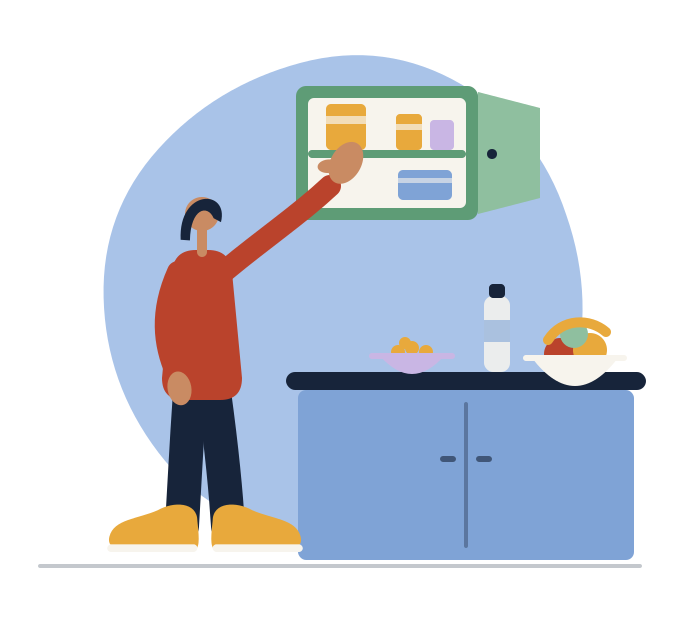
Use it in both directions. Put the two or three foods you find hardest to leave once they're in sight, whatever they are for you, in a cupboard or on a high shelf. Put fruit and a bottle of water on the counter or your desk. Mann says obstacles between you and a food "take advantage of most people's tendencies toward laziness," and adds: "They work even if you know about them and are fully aware of them."
5. Use smaller plates and bowls to serve once
Smaller dishes are the best-known tip and the least proven on their own. In a 2017 reply to readers, the Cochrane authors reported a smaller estimate for plate and bowl size alone, still pointing toward eating more from bigger dishes, while an earlier review of plates and bowls found a small effect that wasn't statistically significant. The authors added that no one yet knows whether people simply refill a smaller plate. So treat a smaller plate or bowl as the container for a portion you serve once, especially for snacks, and leave the refill in the cupboard.
6. Decide before you eat with other people
You can't set up the office, a friend's table or a buffet. A review of 42 studies found that people chose and ate more when they ate with friends than alone. With strangers, there was no clear difference (Ruddock et al., 2019). The authors don't suggest eating alone, which "may be neither desirable nor acceptable"; they suggest strategies instead. The simplest is to decide before you sit down: have some, on a plate, or pass. Write it as one sentence: "When the cake comes around at work, I'll have a slice on a plate, sitting down." Across 23 food studies, such plans helped people add healthy foods more than cut back on others (Adriaanse et al., 2011). Our guide to implementation intentions explains how to write them, and healthy eating at work covers the office.
Give the new setup time to stick
7. Repeat it in the same place, and let a missed day go
Wood says adding "something like a glass of water took two months to become automated." In one study, 96 volunteers chose an eating, drinking or activity habit to do daily in the same context, such as after breakfast. The time to become close to automatic ranged from 18 to 254 days, and missing one day didn't materially set people back (Lally et al., 2010). A review written for family doctors puts the average at about 66 days and traces the popular "21 days" to anecdotes about patients adjusting to plastic surgery (Gardner et al., 2012).
That's an argument for the setup over daily effort: a package in the cupboard works every day without a decision. Habit-based advice has been tested for weight, with modest results. In a trial in English family practices, 537 adults with a higher weight got either a habit leaflet called Ten Top Tips or usual care. The leaflet group lost more weight over three months; by two years, the usual-care group had lost a similar amount (Beeken et al., 2017). Habits change weight slowly, and holding steady counts. Our guides to how to lose weight sustainably and the best diet for weight loss go further.
Start with tonight's snack
Wood's stale popcorn shows how strong a cue can be, and her follow-up shows how little it takes to interrupt it: one small change that makes you notice. Mann describes her own version, a vegetable first every night at dinner: "It's just working with human nature instead of battling it." If you do one thing today, put tonight's snack in a bowl and the package back in the cupboard before you sit down.
If evenings are where it goes off plan, read eating at night; if the cues are feelings, emotional eating. Wood's ideas apply to the evening drink too, in our guide to drinking every night.
To build this around your own days, try the 1h Protocol to Lose Weight Sustainably. Its free first chapter asks a few questions, finds your pattern and gives you one thing to do; when food decides simply by being there, that's every meal and snack on a plate or in a bowl, with the package put away first. The full program is practical education and takes about an hour. It walks one day with you, from the first meal to bed, at your own times, with small kitchen changes as you go and a plan for the "just one" moment. You leave with a page of your chosen changes, a moment card for your lock screen, a fourteen-day sheet with days 7 and 14 in your calendar, and a sentence in your own words for what would tell you it's working, a number included if you want one. The program never sets a target, calories or a diet. Four short check-ins follow by email on days 1, 7, 14 and 30. It isn't for anyone pregnant or breastfeeding, or living with an eating disorder, now or in the past. Start free
Frequently asked questions
Does portion size matter for weight loss?
For how much people eat, yes: adults served bigger portions, packages or plates ate more (Hollands et al., 2015), and smaller portions cut what people ate across a day (Robinson et al., 2023). The evidence on weight itself is thinner: four studies, in which smaller portions went with a little less weight gain.
How do I stop snacking all day?
Make each snack a decision: serve it into a bowl, put the package away, and keep the foods you graze on out of sight. If it's real hunger after a long gap, plan a snack for that gap instead. In one study, slips were more likely when people were hungrier, as well as when tasty food was around (Forman et al., 2017); see always hungry.
Do smaller plates really help?
Possibly a little. Studies of plate and bowl size alone gave a smaller estimate in the same direction, and an earlier review found no statistically significant difference (Hollands et al., 2015). Use a smaller dish to serve a portion once rather than as a trick on its own.
How long does it take to form a habit?
Often longer than the popular 21 days. In one study, daily habits took from 18 to 254 days to become close to automatic, and missing a day didn't matter much (Lally et al., 2010). A review for family doctors suggests expecting about ten weeks (Gardner et al., 2012).
How do I eat less without feeling hungry?
Change what fills the plate. In a year-long trial with 97 women, those advised to eat more fruit and vegetables as well as less fat ate a greater weight of food and reported less hunger than women only told to cut fat (Ello-Martin et al., 2007). People who were served less also made up only part of the difference later in the day. If eating still feels out of your control after two weeks, talk to someone you trust.
Sources
This article draws on Wendy Wood's interview on Hidden Brain and her publisher's record of her book, Traci Mann's interview with NPR, and the reviews and trials listed below.
- Creatures of Habit (podcast episode with Wendy Wood, Hidden Brain, 2019 conversation, page dated 2020)
- Wendy Wood, Good Habits, Bad Habits (book, publisher page, 2019)
- In 'Eating Lab,' A Psychologist Spills Secrets On Why Diets Fail (interview with Traci Mann, NPR The Salt, 2015)
- Hollands et al, Portion, package or tableware size for changing selection and consumption of food, alcohol and tobacco (Cochrane systematic review of 72 randomized trials, 2015, amended 2018)
- Robinson et al, Downsizing food (systematic review and meta-analysis of 14 studies, 2023)
- Forman et al, Ecological momentary assessment of dietary lapses across behavioral weight loss treatment (study of 189 adults in a year-long US program, 2017)
- Hagger et al, A multilab preregistered replication of the ego-depletion effect (replication in 23 labs, 2,141 people, 2016)
- Ruddock et al, A systematic review and meta-analysis of the social facilitation of eating (review of 42 studies, 2019)
- Adriaanse et al, Do implementation intentions help to eat a healthy diet? (meta-analysis of 23 studies, abstract only, 2011)
- Lally et al, How are habits formed: modelling habit formation in the real world (study of 96 volunteers, abstract only, 2010)
- Gardner, Lally & Wardle, Making health habitual (review for general practice, 2012)
- Beeken et al, A brief intervention for weight control based on habit-formation theory delivered through primary care (randomized trial, 537 adults in England, 2017)
- Ello-Martin et al, Dietary energy density in the treatment of obesity (year-long randomized trial, 97 women, 2007)