Exercise
Too old to start strength training? Maria Fiatarone Singh
Strength builds at any age, from a low start. Maria Fiatarone Singh's trial in people in their nineties, and the smallest way to begin.
1h Protocols · October 25, 2026 · 12 min read
You're not too old to start strength training. Muscles respond to training at every age, including in people in their nineties, and the guidelines ask adults of all ages for strength work on at least two days a week. Start lower than you think: five slow sit-to-stands from a solid chair, on one day a week, then build from there.
In 1988, Fiatarone Singh was the physician in a Boston lab running strength studies with healthy older men. Also working in a nursing home, Fiatarone Singh suggested trying the training there, since its residents were the ones who most needed it (5:29). That pilot, published in 1990, is what other researchers now call a seminal study. In the interview with Dr Tony Boutagy, an exercise physiologist, Fiatarone Singh describes what they found: "not only could they do the strength training, but they had remarkable relative gains in strength over just eight weeks" (Boutagy with Fiatarone Singh, 2025, 6:43). "Most of them were in their 90s" (6:54).
Daniel Lieberman, a Harvard professor of human evolutionary biology, calls the opposite belief one of the most damaging ideas about exercise in the West: that "as people get older it's kind of normal to be less physically active" (Big Think, 2022, 2:28). Below: what the research does and doesn't promise, what the guidelines ask, and how to build a strength habit small enough to keep. The seven-step grouping is ours.
Know what the research shows
1. Drop the "too old" idea, and keep the trial in proportion
The "too old" myth has no famous defender. Nobody argues for it out loud; people just assume it. David Scott and Robin Daly, researchers at Deakin University, sum up the trials: all adults, "even very frail people over the age of 75", can make significant gains in muscle and strength with regular resistance training, and "the improvements can be seen in as little as eight weeks" (Scott and Daly, 2023). In the 1990 study they describe, ten frail people aged 86 to 96 living in a care home trained their legs for eight weeks, and leg strength rose by about 180%.
Keep that number in its setting. It was one trial of ten people, lifting heavy loads under close supervision. Building up to those loads within four days went against the practice of the time, Fiatarone Singh recalls, when others took months to get there (6:29). Those are trial conditions, not a plan for a beginner at home. What carries over is the direction: muscles respond to training late in life, and the starting point can be very low.
Lieberman describes the cycle that follows in the West: with age, strength and power drop, basic tasks get harder, activity falls, and fitness falls with it. "As we get older, strength training becomes more and more important," Lieberman says (3:26).
Strength builds at any age, from wherever you start.
2. Know what the guidelines actually ask
The UK's Chief Medical Officers ask adults to do activities that build strength in the major muscle groups on at least two days a week, "but any strengthening activity is better than none". They add that strength work should be considered "as important as achieving 150 minutes" of moderate or vigorous activity a week (UK Chief Medical Officers, 2019). The WHO gives the same two-day direction for adults and older adults (WHO, 2020).
Two days is a direction, not the entry ticket. US guidance says strength activities "can be done just 1 day a week starting at a light or moderate level of effort" at first, then two days over time (Physical Activity Guidelines for Americans, 2018, p. 63). The same guidance tells inactive adults to "start low and go slow".
Long-term studies point the same way. In a 2022 review of 16 studies that followed adults over years, regular strength work was linked with better long-term health, separately from aerobic activity, and the strongest links came with modest weekly amounts; more wasn't clearly better (Momma et al., 2022). These are associations, so they can't show that strength work alone made the difference.
Start smaller than you think
3. Check before you start, if any of these apply
Advice differs on whether to see a doctor first, and the 1h Protocol to Build an Exercise Routine puts it this way: "The NHS suggests speaking to your GP first if you haven't exercised for a while. WHO and US guidance say that for light to moderate activity, like brisk walking, that's generally not needed. If checking would put your mind at rest, do."
Some situations do call for a doctor first. Check with a doctor before you start, then come back to your plan, if you have chest pain, pressure or fainting when you're active; your heart pounds, skips or races, or you feel dizzy or unusually short of breath when active; a heart, kidney or metabolic condition, or another long-term condition or symptoms you're unsure about; a doctor has told you to limit your activity; or you've had recent surgery, a heart event, an injury or an illness. With a cold or fever, wait until you're better. If you're pregnant or recently gave birth, agree your choices with your midwife or doctor (UK Chief Medical Officers, 2026).
Keep the NHS rule for every session: "Stop the exercise immediately if you feel any pain or become unwell" (NHS, Strength and Flex). And if new symptoms appear as you do more, talk to a doctor.
4. Begin with five slow sit-to-stands
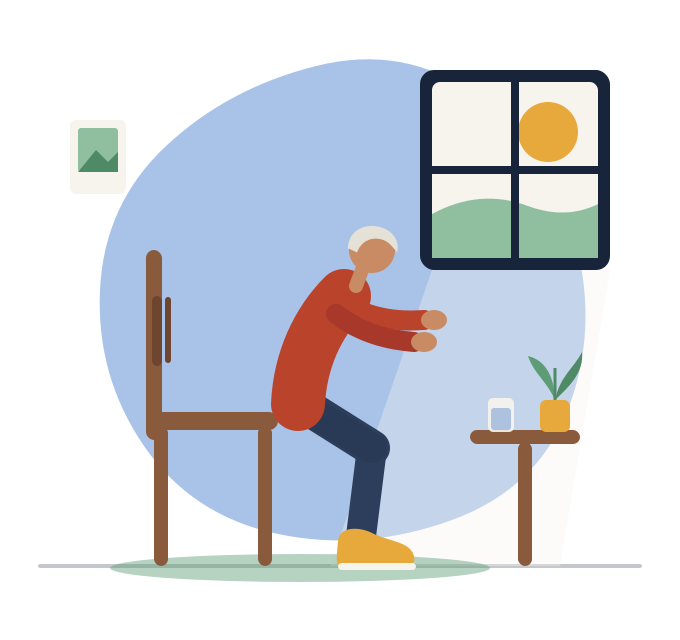
The smallest strength session needs one solid chair without wheels or arms. The NHS describes it: sit on the edge of the chair, feet hip-width apart, lean slightly forward, stand up slowly using your legs, then sit down slowly. "Aim for 5 repetitions. The slower the repetitions, the better" (NHS strength exercises).
Fiatarone Singh asks students to picture someone getting out of a chair: standing up takes strength, and staying up takes balance (19:50). The sit-to-stand trains the first.
Starting this small also helps the habit. In a study of new daily habits led by Phillippa Lally, as the research team later summed it up, simple actions such as drinking water became automatic sooner than elaborate routines such as doing 50 sit-ups (Gardner, Lally and Wardle, 2012). Five slow sit-to-stands is closer to the glass of water.
Here's what that looks like in practice. After breakfast on Monday, before you clear the table, do five slow sit-to-stands from the kitchen chair. That's the whole session.
5. Add the rest of a small set when five feels easy
When the sit-to-stands feel easy, the same NHS page adds a few moves that need only the chair and a wall: five mini-squats holding the back of the chair, five slow calf raises, and wall press-ups, working toward three sets of five to ten. With the sit-to-stands, that works your legs, hips, chest, shoulders and arms. NHS guidance asks for strength work that covers the major muscle groups (NHS, adults 19 to 64), and filled water bottles will do for the arm curls.
How hard should it feel? For strength exercises, the NHS says to do them "to the point where you need a short rest before repeating the activity" (NHS, 65 and over). You don't need to feel sore the next day for it to count; see no pain, no gain. Scott and Daly suggest starting with very light weights or easier versions of bodyweight moves, such as "a push-up against a wall or windowsill instead of on the floor", and making them harder over time. If you later want a moderate to high intensity program with weights, they advise talking to a health professional first; an accredited exercise professional can design one.
Carrying heavy shopping, yoga, tai chi, resistance bands and heavy gardening count too, the NHS says. If a gym appeals, see our guide to gym anxiety.
Keep it going for months
6. Tie it to something you already do, and count the week
A strength session that floats tends to get pushed. Give it a slot right after something you never skip, like breakfast or the end of your last call, and a back-up slot for the day the first one goes. Our guides on making exercise a habit and the best time to work out go further.
Count the week, not the days in a row. One strength day this week is a real week. When one day feels routine, US guidance suggests moving to two, "and then possibly to more than 2", with the effort rising slightly each week until it's moderate or greater. Short sessions count; see do short workouts count?.
7. Grow one thing at a time, and come back lower after a break
Fiatarone Singh's trial had a second lesson. When the training stopped, the residents lost part of what they had gained within weeks, and the lesson Fiatarone Singh drew was to keep it going (8:25). That's why the habit matters more than any single hard session.
So grow slowly: after two steady weeks, add one thing, never two, such as a few more repetitions, one more move or a second day. After a break for illness or travel, US public health advice is to "start again at a lower level and slowly work back up to your usual level of activity" (CDC, 2025). Our guide to getting back into exercise covers the comeback.
After 65, add balance. The NHS asks adults 65 and over to do activities that improve strength, balance and flexibility on at least two days a week, and says these exercises help you feel "more confident on your feet". Standing on one leg while holding the back of the chair, tai chi and dancing all count. The WHO suggests older adults do varied activity that emphasizes balance and strength on three or more days a week.
Back to the nursing home
Fiatarone Singh's residents were in their nineties, frail, and living in care. They did the training, and they got stronger in eight weeks. Your start can be far gentler than theirs and still head the same way: five slow sit-to-stands, one day a week, in a slot you already have.
"So as we get older, let's not cut back on the physical activity," Lieberman says. "Let's maintain it, do some strength, do some endurance" (4:01).
To build strength into a routine that fits your own week, try the 1h Protocol to Build an Exercise Routine, a program of practical education. Its free first chapter starts with a quick check, asks a few short questions about how your last try at exercise ended, finds your pattern (one of five, or the Tune-up) and gives you one thing to do tomorrow. If the check suggests a word with a doctor first, the activity parts of your plan wait until you've checked. The full program takes about an hour: it sets your full version, a short version for hard days and your weekly number, builds one session with you, with a back-up slot, and plans the slot after a miss. It includes the sit-to-stand and a small chair-and-wall strength set, kept on your page as a strength line for after two steady weeks. You leave with your page, a log that counts the week with planned skips, and your slots and review days 7, 14 and 30 in your calendar. Four one-tap check-ins follow by email on days 1, 7, 14 and 30, if you're signed in. Start free
Frequently asked questions
Am I too old to start strength training?
No. Trials show that adults of every age, including very frail people over 75, gain strength with regular resistance training, with improvements in as little as eight weeks (Scott and Daly, 2023). Start low and build slowly, and check with a doctor first if you have symptoms when active, a heart condition, or have been told to limit activity.
How often should a beginner do strength exercises?
One day a week is a fine start. US guidance says strength work can begin on one day at a light or moderate effort and move to two days over time (Physical Activity Guidelines for Americans, 2018). The UK and WHO direction is at least two days a week, and any strength activity is better than none.
Can I do strength training at home without equipment?
Yes. The NHS's free strength routine uses a solid chair and a wall: sit-to-stands, mini-squats, calf raises and wall press-ups, with filled water bottles for arm curls (NHS strength exercises).
Do I need to lift heavy weights?
No. Work each move until you need a short rest before repeating it, and make it slightly harder over time (NHS). If you want a heavier weights program later, talk to a health professional first.
Why does balance matter after 65?
Standing up takes strength and staying up takes balance. The NHS asks adults 65 and over to do activities for strength, balance and flexibility on at least two days a week, and says they help you feel more confident on your feet. Standing on one leg while holding a chair, tai chi and dancing all count.
Sources
This article draws on Prof Maria Fiatarone Singh's interview with Dr Tony Boutagy, Prof Daniel Lieberman's Big Think video, Scott and Daly's article in The Conversation, a review of long-term studies of strength work, a review of habit research, and public guidance from the UK, WHO, the US and the NHS.
- Building Muscle in your 80s and 90s, Dr Tony Boutagy with Prof Maria Fiatarone Singh (video interview, 2025)
- Harvard professor debunks the biggest exercise myths, Daniel Lieberman (video, Big Think, 2022)
- Scott and Daly, Am I too old to build muscle? (researchers' article, The Conversation, 2023; describes a 1990 trial of ten care-home residents aged 86 to 96)
- UK Chief Medical Officers' Physical Activity Guidelines (government guideline, 2019, updated 2026)
- WHO guidelines on physical activity and sedentary behaviour (guideline, 2020)
- Physical Activity Guidelines for Americans, 2nd edition (government guideline, US, 2018)
- NHS, Physical activity guidelines for older adults (health information page, 2024)
- NHS, Physical activity guidelines for adults aged 19 to 64 (health information page, 2024)
- CDC, Older adults: adding activity recommendations (health information page, US, 2025)
- NHS, Strength exercises (free routine, 2024)
- NHS, Strength and Flex exercise plan: how-to videos (free videos, 2025; named, not linked, because the page prints a phone number)
- Momma et al., Muscle-strengthening activities and risk of major non-communicable diseases (systematic review and dose-response meta-analysis of 16 cohort studies, British Journal of Sports Medicine, 2022)
- Gardner, Lally and Wardle, Making health habitual (review of habit research, British Journal of General Practice, 2012)
- UK Chief Medical Officers, Physical activity guidelines for pregnancy and after childbirth (guideline infographics, 2026)