Phone and focus
How to focus: Amishi Jha's approach to a wandering mind
How to focus: one task at a time, your phone out of reach, and the habit of noticing when your mind wanders. Amishi Jha's approach, and what her studies show.
1h Protocols · October 6, 2026 · 13 min read
To focus, give your attention one task at a time, keep your phone out of reach while you work, and count the moment you notice your mind has wandered as the skill itself. That's the approach of the neuroscientist Amishi Jha, who sees a wandering mind as normal: the aim is to catch the drift sooner and keep the way back short.
Jha describes a familiar moment. You're reading a book, you reach the bottom of the page, and you have no idea what the words were saying (TEDx, 10:15). Your mind had gone to yesterday or tomorrow, and you didn't notice it leave. She calls it mental time travel, and says we land there "most times without our awareness."
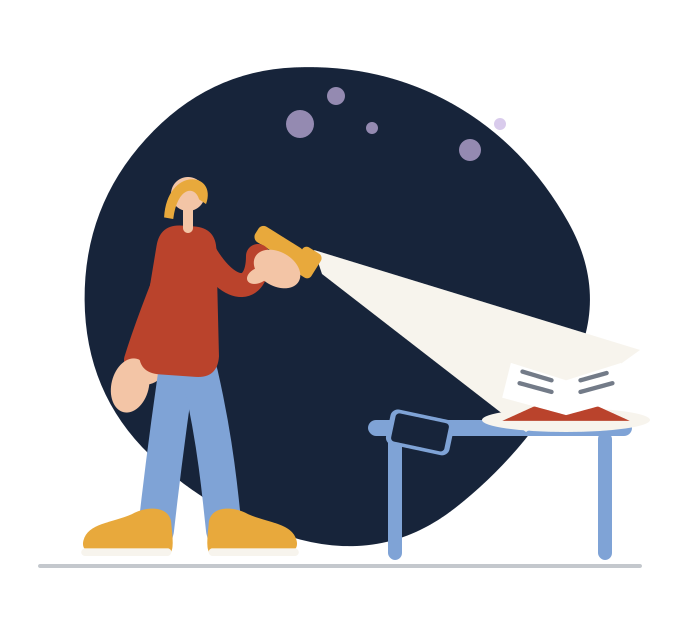
Jha, a professor of psychology and the author of Peak Mind (Hachette), tests attention in people going through long, demanding stretches: soldiers before deployment, firefighters, students over a semester. Her model is a flashlight: you can point it, things can grab it, and you have only one (HBR IdeaCast). Her work and the neuroscientist Adam Gazzaley's give you five steps, two for before you start and three for when your mind leaves, and the evidence to judge her daily practice for yourself.
Set up the room before you start
The flashlight "can also be grabbed or yanked," Jha says, by a rustle on a dark path or a thought from inside (The Mel Robbins Podcast, 16:32). A buzz from your pocket does the same, so the first two steps change what's around the flashlight first.
1. Give your attention one job
"Multitasking actually doesn't exist," Jha says. "What we're doing is task switching" (The Mel Robbins Podcast, 17:35). In four experiments with University of Michigan undergraduates, people were slower when they alternated between two tasks than when they repeated one, and slower still when the tasks were complex (Rubinstein et al., 2001). The American Psychological Association notes that a switch can cost "just a few tenths of a second," which adds up when you switch back and forth all day (APA, 2006).
Say you need to read a report. Before you open it, write the block's one job at the top of a page: "Sections 2 and 3, and three questions for Thursday." Close email and chat. When something else comes to mind, write it below the line and go back. If switching is built into your job, see focus at work.
2. Put your phone where reaching for it takes a decision
Gazzaley, a professor at the University of California, San Francisco, and co-author of The Distracted Mind (MIT Press), sees two pushes out of a task: boredom or worry from inside, and the next distraction within reach (Making Sense, 20:31). He starts with the second, because it's "a little easier" (28:11).
"Limiting accessibility is just a really simple way to start decreasing that switching tendency." Adam Gazzaley, Making Sense
In a 2016 trial, 221 University of British Columbia students spent a week with alerts off and the phone out of sight, and a week with alerts on and the phone in reach (Kushlev et al., 2016). They rated themselves slightly less inattentive in the out-of-sight week, by about a tenth of a point on a four-point scale, with no direct change in how productive they felt. That's a small difference, from a change that costs nothing.
You may have heard that a phone on the desk drains your brain even when you ignore it. A 2024 review of 33 studies found no effect of a phone's mere presence on thinking tasks on average (Hartanto et al., 2024), and a second review found only a small dip in working memory (Parry, 2024). Distance helps because when the phone isn't in your hand or pocket, picking it up takes a decision. Our guide to reducing screen time covers where the phone can live.
Jha turned off the notifications on her social media and calls it "such a freedom" (Mind & Life Podcast, 48:33). For which alerts to keep, see turning off notifications.
What to do when your mind wanders
Even in a quiet room with one task, your mind will leave. "If you are a human being who is conscious, you are going to mind wander," Jha says (HBR IdeaCast). Across 25 papers with 3,926 participants, people who mind-wandered more while reading tended to understand less. The link was modest, and it doesn't show which causes which (Bonifacci et al., 2022). If you've read that attention now lasts only 47 seconds, our piece on attention span explains what that number measures.
3. Count the noticing as the win
Jha's basic exercise is three moves on repeat: point your attention at the breath, notice when it has wandered, bring it back. When the flashlight won't stay put, her instruction skips the irritation ("Darn it") and goes straight back to the breath: "That moment of noticing is a win" (HBR IdeaCast).
The same move works without meditating. Kim Willment, a neuropsychologist at Brigham and Women's Hospital, suggests reading for 30 minutes with a timer that rings every five; each time, ask whether your mind has wandered, and if so, go back to the page (Harvard Health, 2023). She offers it as a suggestion; it hasn't been tested.
Say that on page four of the report, you realize you've been planning dinner. Skip the scolding, say "drifted" and go back to the last sentence you remember.
4. Take a break before your focus fades
In one of Jha's lab tasks, people held faces in memory over a session of about 20 minutes, and their minds wandered more the longer it ran (Mind & Life Podcast, 39:09). Her advice is to stop before that point: "take a pause, go walk around and get your mind fresh again, and then re-engage" (40:59).
Gazzaley found an hour of single focus "shockingly hard" at first. He advises starting with short periods, building up the way a runner builds distance, and spending breaks away from social media, stretching or looking at nature (Making Sense, 29:12). For fixed timers, see the Pomodoro technique guide. If the trouble is starting at all, see how to stop procrastinating.
5. When you're stuck, STOP
When you can't get back, Jha uses a short practice called STOP: stop, take one breath, observe what's going on around you and inside you, then proceed. She suggests doing it "anytime you're stopped" (The Mel Robbins Podcast, 1:13:16), and uses it herself at elevators. Afterward, she says, the flashlight is back in your hand, at "a neutral point from which you can reenter the task" (HBR IdeaCast).
Those stopped moments are also when the phone comes out. Jha admits that in a coffee line she'd usually be clearing email: "I'm not going to let a minute go wasted" (Mind & Life Podcast, 47:40). Yet she calls time for the mind to roam "a lifeline" (46:36). One wait a day with a STOP instead of the phone gives your mind some of that time.
Does mindfulness help you focus? What Jha's studies showed, and in whom
Jha's best-known recommendation is the exercise from step 3 as a daily practice: 12 minutes a day, four days a week, for at least four weeks, starting with three minutes after something you already do, like your morning coffee (The Mel Robbins Podcast, 54:07 and 1:00:32).
The 12 minutes came from looking back: in her early studies, military service members and firefighters were asked to practice 30 minutes a day and log it, almost nobody reached 30, and those who logged about 12 or more held up on the attention measures while those who did less didn't (The Mel Robbins Podcast, 52:56). "This was just happenstance," Jha says. "We found that 12 minutes was it, but that wasn't really a test" (54:07). She limits the answer to high-stress groups, and to attention, mood and stress (10% Happier, 29:42).
In a 2015 study of US Army soldiers preparing for deployment, units that took a practice-based eight-hour program held their scores on a sustained-attention test steady over eight weeks, while a no-training military group and a lecture-based group declined (Jha et al., 2015). The groups in that study differed at the start. In a 2019 study of 120 elite special-forces servicemen, a four-week version was linked to small gains on attention and working-memory tests compared with no training; a two-week version wasn't (Zanesco et al., 2019). Neither study compared mindfulness with a different activity, whole units rather than individuals were assigned, and both were small studies of military men.
In adults generally, the evidence is weaker. A 2022 review of 45 randomized trials with 2,238 adults found that group mindfulness programs made no reliable difference to attention tests, and their small overall gains held up against doing nothing but not against other activities (Whitfield et al., 2022). A 2021 analysis of 25 controlled studies with 1,439 participants also found no significant gain in attention (Im et al., 2021). Exercise often gets the same promise. A review of trials in healthy people found that the effect on thinking reported in earlier reviews "has likely been overestimated" (Ciria et al., 2023).
If you want to try her practice, run it as an experiment: three minutes after your morning coffee for two weeks. Judge it by one question: do you catch your drifts sooner? If it makes you feel worse, stop. The five steps don't depend on it.
Back to the bottom of the page
Jha's example was the page you finish without knowing what it said. Her answer changes two things around that moment: the room, with one task and the phone out of reach, and what you do when you notice your mind has gone, which is to skip the scolding and go back to the last line you remember. Her TEDx talk closes on a five-word call to action: "Pay attention to your attention" (TEDx, 17:25).
The 1h Protocol to Take Control of Your Phone works on the phone part of that room, on your own phone. Its free first chapter finds your pattern from a few questions and your phone's own numbers and gives you one thing to do today. The full program, about an hour of education, has you change your phone's settings as you go and ends with a personal protocol built from your answers: two habits to start with, a lock-screen card and reviews on day 7 and day 14, then four short check-ins over 30 days. Start free
Frequently asked questions
Why can't I focus?
Your mind drifts, usually without telling you, and anything within reach, like a tab or a phone, gives it somewhere to go. Long stretches make it harder: in Amishi Jha's lab tasks, minds wandered more the longer people worked. Work on one task, keep the phone away and break before you fade. If your focus still feels out of your control after a couple of weeks of changes like these, talk to someone you trust.
How do I focus on one thing at a time?
Write down the one thing a block of time is for, close every other window and put the phone in a bag or another room. Start with a block you can manage: Adam Gazzaley found an hour of single focus "shockingly hard" at first and builds up gradually (Making Sense). When your mind wanders, notice it and go back.
Does mindfulness help you focus?
Not reliably, on current evidence. In one of Amishi Jha's studies, soldiers who practiced before deployment kept their attention steady while comparison groups declined. But a review of 45 randomized trials in adults found no reliable gain on attention tests (Whitfield et al., 2022). To try her practice, start with three minutes a day, as an experiment.
Is multitasking bad for focus?
For two tasks that both need thought, yes. You aren't doing them at once; you're switching, and in lab studies each switch cost time, more for complex tasks (Rubinstein et al., 2001). People who often use several media at once report slightly more everyday attention slips, a small link with no known direction (Parry & le Roux, 2021).
Does keeping my phone nearby hurt my focus?
Not by being there, on average. A review of 33 studies found no effect of a phone's mere presence on thinking tasks on average (Hartanto et al., 2024). Distance helps for a simpler reason: a phone in a bag or another room is one more step away. In one student study, a week with alerts off and the phone out of sight felt a little less distracting (Kushlev et al., 2016).
Sources
This article draws on Amishi Jha's TEDx talk and her interviews on The Mel Robbins Podcast, HBR IdeaCast, the Mind & Life Podcast and 10% Happier, Adam Gazzaley's interview on Making Sense, and the studies and public guidance listed below.
- Amishi Jha, How to tame your wandering mind (TEDx talk, 2017)
- The Mel Robbins Podcast, Ep. 337: Amishi Jha, 12 minutes to a better brain (podcast episode, 2025)
- HBR IdeaCast, Ep. 825: Amishi Jha, Find focus in a chaotic world (podcast episode, 2021)
- Mind & Life Podcast: Amishi Jha, Attention, mind wandering, and stress (podcast episode, 2020)
- 10% Happier: Amishi Jha, The science of training your attention (podcast episode, 2023 reissue)
- Amishi Jha, Peak Mind (book, publisher page, 2021)
- Making Sense #226: Adam Gazzaley, The price of distraction (podcast episode, 2020)
- Adam Gazzaley and Larry Rosen, The Distracted Mind (book, publisher page, 2016)
- Rubinstein, Meyer & Evans, Executive control of cognitive processes in task switching (four lab experiments with undergraduates, 2001)
- American Psychological Association, Multitasking: switching costs (research summary, 2006)
- Parry & le Roux, Cognitive control in media multitaskers ten years on: a meta-analysis (meta-analysis of 46 cross-sectional studies, 2021)
- Kushlev, Proulx & Dunn, Silence your phones (within-subject field experiment, 221 students, 2016)
- Hartanto et al, The effect of mere presence of smartphone on cognitive functions: a four-level meta-analysis (meta-analysis of 33 lab studies, 2024)
- Parry, Does the mere presence of a smartphone impact cognitive performance? A meta-analysis of the brain drain effect (preregistered meta-analysis, 2024)
- Bonifacci et al, The relationship between mind wandering and reading comprehension: a meta-analysis (meta-analysis, 25 papers, 3,926 participants, 2022)
- Harvard Health Publishing, Tips to improve concentration (public health guidance, 2023)
- Jha et al, Minds "at attention": mindfulness training curbs attentional lapses in military cohorts (quasi-experimental study, US Army soldiers, 2015)
- Zanesco et al, Mindfulness training as cognitive training in high-demand cohorts (training study, 120 elite servicemen, 2019)
- Whitfield et al, The effect of mindfulness-based programs on cognitive function in adults (systematic review and meta-analysis of randomized trials, 2022)
- Im et al, Does mindfulness-based intervention improve cognitive function? (meta-analysis of 25 controlled studies, 2021)
- Ciria et al, An umbrella review of randomized control trials on the effects of physical exercise on cognition (umbrella review, 2023)