Worry and overthinking
Overthinking at night: why bed starts the loop, and what helps
Overthinking at night is often a habit tied to the bed. A five-minute list before lights out, a few words for tomorrow, and getting up if it keeps you awake.
1h Protocols · October 26, 2026 · 13 min read
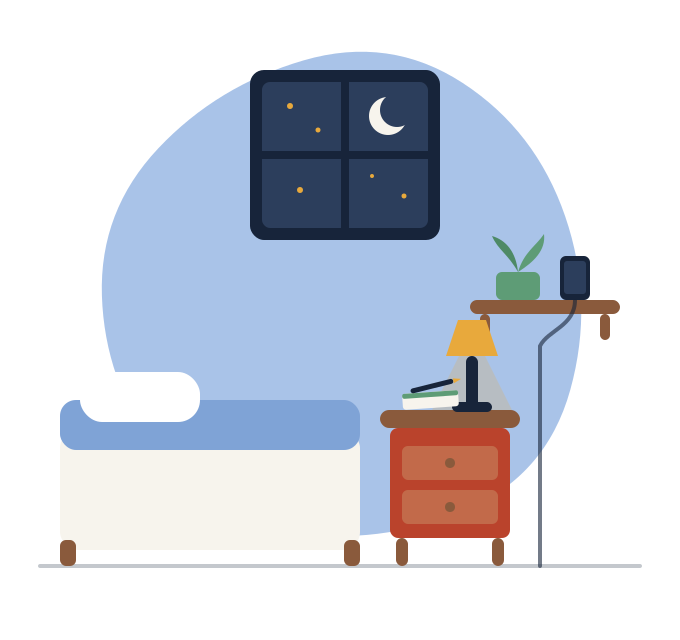
Overthinking at night often starts because the bed has become a place to think. To loosen the habit, give tomorrow somewhere to go before lights out: five minutes, a to-do list on paper, and the notebook somewhere off the bed. When a worry turns up anyway, write a few words for tomorrow and lie back down. If it keeps you awake, get up for a while. And give your worries a time of their own, earlier in the day.
Ehring has spent his career studying what German calls Grübeln, going over the same thoughts again and again. On the German podcast Ist das noch gesund?, the host asked him why so many people wake in the night and can't let go of their thoughts (9:13). His answer had two parts: the setting, and habit. And when Psychologie Heute asked him when going over things becomes a problem, he picked one scene: "Der Klassiker ist: abends im Bett" (the classic is in bed, in the evening).
This article stays on the worry and the bed as its cue. For the sleep side, see our guides to sleep anxiety and waking at 3am.
Why does overthinking start when you lie down?
1. Nothing else is asking for your attention
By day, your mind has the world to react to: people, tasks, noise. In bed, the room goes dark and quiet, and whatever you carried through the day gets the floor. Ehring's research finds that going over things shows up mostly "wenn wenig Außenreize da sind" (when there's little from outside to react to). Lying in bed wanting to sleep is a typical case, he says, and so is waking in the night (9:20).
2. Repeated there often enough, the bed becomes the cue
Going over things exists to solve problems, Ehring explains. But when someone does it a lot, it often turns into a habit that no longer needs a real problem in front of it (9:35). If you've spent many evenings in bed thinking about your troubles, the bed can become "sozusagen zu einem Auslöser" (a trigger, so to speak) for the loop (10:04). Psychologists call that a habit: something in the setting leads to a behavior because the two have so often come together.
On Bavarian public radio (BR Radiowissen), he walked through how it starts (15:23). During a hard stretch, the thinking begins every night once the distractions are gone. In time it can run even after the problems have passed: "Die Situation kann das automatisch auslösen" (the situation can set it off automatically).
That's an expert's account of how the habit forms. The bed doesn't cause the loop; it's where the loop has had the most practice. It also fits a wider pattern. A 2020 review pooled 55 studies with 181,366 people from the general population and found that those who worried or went over things more tended to report poorer sleep, a small to moderate link (Clancy et al., 2020). Most of those studies measured both at one time, so which comes first is unknown.
3. In the small hours, a worry looks bigger
Many people notice that a worry at 3 a.m. seems larger than the same worry over breakfast. Sleep researchers have proposed an idea they call "the mind after midnight": mood follows a daily rhythm and is lowest at night, and the brain's usual brake on dark thoughts may be weaker then (Tubbs et al., 2022). They write that every part of the idea still needs testing.
The psychologist Patricia Ramírez gave the everyday version on El podcast de Cristina Mitre: at night you can feel far sadder and more useless, and see problems you probably wouldn't see in the morning with a clearer head (9:10). The rule that follows:
Treat the size of a night worry as tiredness talking.
Before lights out: give tomorrow somewhere to go
4. Write tomorrow's to-do list for five minutes
The simplest step has a lab study behind it. In a 2018 experiment at Baylor University, 57 healthy adults aged 18 to 30 each spent one night in a sleep lab. Just before lights out, they wrote for five minutes, either a to-do list for the next few days or a list of what they'd done over the past few days. The to-do group fell asleep in about 16 minutes on average, against about 25 for the other group: about nine minutes faster. And the more specific the to-do list, the faster they fell asleep (Scullin et al., 2018).
Know its limits: one night, young healthy adults, a comparison with another kind of writing rather than none, and no measure of worry itself. Treat it as a cheap thing worth trying, not a promise.
Here's what that looks like in practice. Leave a notebook and pen where you'll see them as you get ready for bed. Write what's coming tomorrow and the next few days, as specifically as you can: "Call the bank about the card, after the 10 o'clock meeting" does more than "money stuff". Too tired to write much? Three words per item are enough.
5. Make each line a step, not a story
A to-do list is a different thing from pages about how you feel. The psychologist Yves-Alexandre Thalmann explained the difference on the French podcast Métamorphose (23:57). Research has found that action plans can quiet thoughts that keep popping up, Thalmann said, as long as they're "des vrais plans d'action avec du concret. Qui, quoi, quand, où, comment" (real action plans, concrete ones: who, what, when, where, how). Once the plan is made, for the brain "c'est dans le pipeline" (it's in the pipeline, 24:35).
Lab studies with students point the same way. Writing a specific plan for an unfinished task stopped it coming back to mind, even before the task was done (Masicampo & Baumeister, 2011). They were short experiments, so read them as a direction.
The psychologist Hannah Anda, on the Spanish-language channel Mente en Pausa, gives a bedtime version (7:45). Keep a notebook by the bed and write the three to five things going round your head. Each can be "un pendiente real o un miedo hipotético" (a real task or a hypothetical fear). Then add one short line: "Ahora toca descansar, mañana lo puedo resolver" (now it's time to rest; I can sort it out tomorrow). Keep it that short: a few words and a next step.
6. Put the notebook off the bed, and the phone across the room
Ramírez asks for paper: "una libretita y no el móvil" (a little notebook, not the phone, 41:24). Open the phone to write a note, she says, and you may find yourself checking Instagram while you're there. Once the list is written, put it somewhere off the bed: a shelf, a drawer, the floor. That keeps the list out of reach once you lie down, and it keeps the bed for sleep.
The same goes for the last hour before sleep. Charge the phone away from the bed, and if a work message comes to mind, it goes on tomorrow's list instead of into a reply.
When a worry finds you in bed anyway
7. Park it in a few words for tomorrow
When the host asked Ehring for a stop button, he said there isn't one (15:39). Trying hard not to think about it doesn't help: ask someone not to think of a pink elephant for a minute, he said, and afterwards pink elephants are everywhere (15:59). Our guide on how to stop overthinking explains why pushing a thought away tends to bring it back.
Thalmann's alternative is to postpone the thought instead of fighting it (41:07). Woken at 3 a.m. by a worry, Thalmann acknowledges it and tells the brain: "c'est important, mais pas maintenant" (it's important, but not now). Then comes a plan for the next day. In Thalmann's version, that's half an hour after waking (41:31). A shorter slot earlier in the day works too (step 9).
In practice: write three words on the notebook, enough to find the worry again, and lie back down. Ehring suggests the same when it's a real problem or something to do tomorrow: take a sheet of paper and write it down (17:02).
8. If it keeps you up, get up
If the few words don't settle it and you're still going round, lying there makes the bed a place for sorting. At that point, Ehring suggests breaking the habit: get up, have something to drink or do something else for a while, and lie down again once you've calmed down (16:41).
Sleep specialists give the same advice for nights you can't sleep: go to bed when sleepy, get up when you can't sleep, and keep the bed for sleep. Trials with adults who have long-term sleep problems found it helped a modest amount (Edinger et al., 2021), so treat it as a sleep habit worth trying. Spain's Andalusian health service puts it plainly in its worry booklet: if a new worry keeps you up, get up and add it to your list, because bed isn't the place to look for solutions (Servicio Andaluz de Salud). Our 3am guide covers what to do once you're up.
9. Give your worries a time of their own, earlier in the day
Bedtime is often the first quiet moment all day, so the worries wait for it. Give them an earlier appointment. The same Andalusian booklet suggests about 20 minutes in the afternoon with a notebook, writing each problem with how and when you'll tackle it. If it comes back at bedtime, the plan already exists.
Our guide to worry time shows how to set up a short daily slot, early in the evening and well away from bed, with a back-up time for busy days. And for the 3 a.m. voice, try talking to yourself in the third person.
Back to the bed
Ehring's point is that the night loop is mostly practice, and practice can be changed. It takes a while: habits like this don't change "von einem Tag auf den anderen" (from one day to the next), he told Psychologie Heute. The Bavarian radio feature puts the hopeful part plainly: "die Gewohnheit … kann durchbrochen werden" (the habit can be broken, 15:44). Start with the five-minute list tonight.
This is wellness guidance about everyday worry and overthinking, not health care. It doesn't give medical advice, and it doesn't diagnose or treat anything. It isn't for anxiety disorders, panic, OCD, trauma or depression. If worry doesn't ease, or it starts causing problems at work, at home or with friends and family, see a doctor. See one too if what you're trying isn't helping.
To build this around your own nights, try the 1h Protocol to Reduce Worry and Overthinking, a program of practical education for adults. Its free first chapter finds which of five common loops yours follows (the Night Loop is one), shows the three parts that keep it going, and gives you one first step to try. The full program takes about an hour: you catch one worry of your own and park it with one next step, set a short daily slot at your own time and place, and plan for the moment you're awake and it won't stop, with a line in your own words. You leave with a page of the changes you chose, a card with your slot and three questions to ask when a worry starts, and a fourteen-day log with a day-7 question and a day-14 review in your calendar. If you're signed in, four one-tap check-ins follow by email on days 1, 7, 14 and 30. Start free
Frequently asked questions
Why do I overthink at night?
At night there's little else to hold your attention, and going over things shows up most in quiet, low-input settings, says Thomas Ehring of LMU Munich (Ist das noch gesund?, 9:20). Do it in bed often enough, and the bed itself can become the cue.
Why do worries feel worse at 3 a.m.?
Mood follows a daily rhythm and is lowest at night. Sleep researchers think the brain's brake on dark thoughts may be weaker then, which could make a worry look bigger (Tubbs et al., 2022). It's still an idea being tested, so look at the worry again in daylight.
Does writing a to-do list before bed help you sleep?
In one sleep-lab study, 57 healthy adults aged 18 to 30 who wrote a five-minute to-do list fell asleep about nine minutes faster than those who listed what they'd already done (Scullin et al., 2018). It was one night, so treat it as a promising start.
What should I do if a worry keeps me awake?
Write a few words, enough to find it again tomorrow, and lie back down. If you're still awake and going round, get up, do something calm in low light elsewhere, and go back to bed when sleepy. Give the worry its own time the next day.
Should I keep a notebook by the bed?
Yes: a small notebook and pen, close but off the bed. The psychologist Patricia Ramírez suggests paper over the phone, so you don't end up scrolling (41:24). Keep entries to a few words and one next step.
Sources
This article draws on Prof. Thomas Ehring's interviews on Ist das noch gesund?, BR Radiowissen and in Psychologie Heute, on Yves-Alexandre Thalmann, Patricia Ramírez and Hannah Anda, and on the studies and guidance listed below. Quotes in German, French and Spanish are given in the original with our English gloss.
- Overthinking: Wenn der Kopf nicht zur Ruhe kommt, with Prof. Dr. Thomas Ehring (podcast episode, Ist das noch gesund?, German, 2022)
- Raus aus der Grübelfalle: Wenn Gedanken sich im Kreis drehen (radio feature with Thomas Ehring, BR Radiowissen, German, 2025)
- Beim Grübeln wird man eben nicht konkret (magazine interview with Thomas Ehring, Psychologie Heute, German, 2024)
- Scullin et al, The effects of bedtime writing on difficulty falling asleep (randomized sleep-lab experiment, 57 healthy adults aged 18 to 30, one night, 2018)
- Clancy et al, worry, going over things and sleep (systematic review and meta-analysis, 55 papers, 181,366 people from the general population, mostly measured at one time, 2020)
- Tubbs et al, The mind after midnight (review proposing a hypothesis, not yet tested, 2022)
- Masicampo & Baumeister, Consider it done! Plan making can eliminate the cognitive effects of unfulfilled goals (lab experiments with students, abstract only, 2011)
- Edinger et al, American Academy of Sleep Medicine systematic review (systematic review of behavioral approaches for adults with long-term sleep problems, 2021)
- Servicio Andaluz de Salud, ¿Cómo hacer frente a las preocupaciones? (public health service booklet, Spanish, 2013 edition)
- Yves-Alexandre Thalmann with Anne Ghesquière (podcast episode, Métamorphose, French, 2026)
- Hannah Anda, Cómo dejar de sobrepensar en la noche (video, Mente en Pausa, Spanish, 2025)
- Patricia Ramírez on El podcast de Cristina Mitre (podcast episode 360, Spanish, 2025)