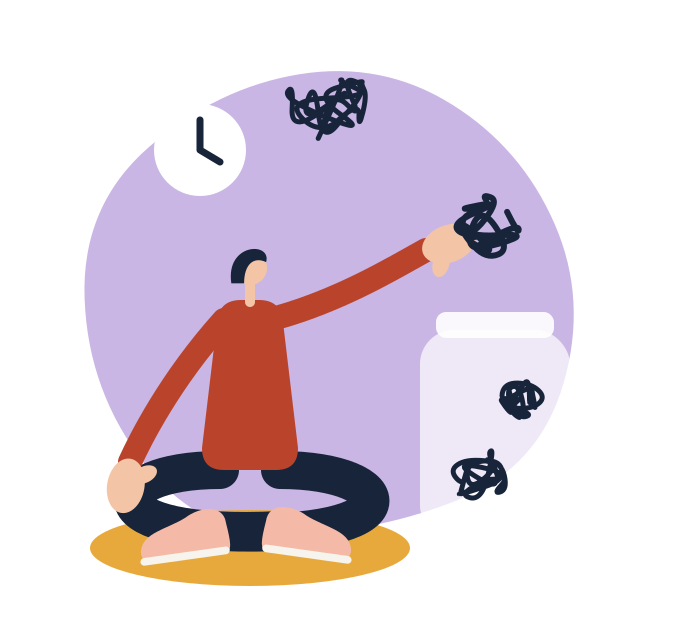
Worry and overthinking
How to stop overthinking: Dr Tracey Marks on thinking that ends
How to stop overthinking: tell going over things from solving a problem, find your loop's pattern, and give the worry a step and a time. Sourced.
1h Protocols · October 26, 2026 · 12 min read

To stop overthinking, first tell it apart from problem-solving: thinking that helps moves toward a step and then ends. When a thought starts going round, name it, ask whether you can act on it now, and either take the step or park the worry in a few words with a set time to come back to it. Then return to what you were doing.
"Problem solving has a beginning, a middle, and an end," says Marks in a video on overthinking (1:53). You define what you need to solve, gather what you need, and work through a plan. "And then there's a sense of progress, even if it's slow progress" (2:15). Overthinking has none of that shape. You replay the conversation, turn over the details, run the "what ifs", and end up where you started, only more tired.
You're far from alone. Gallup asks people aged 15 and older in about 140 countries how they felt yesterday. In 2025, a median of 38% across those countries said they felt worry during a lot of the day (Gallup, 2026).
A word on scope before the steps. This article is about everyday worry and overthinking. The 1h Protocol to Reduce Worry and Overthinking is a wellness program about everyday worry and overthinking, not health care. It doesn't give medical advice, and it doesn't diagnose or treat anything. It isn't for anxiety disorders, panic, OCD, trauma or depression.
Below, Marks's test and questions are joined with the work of Thomas Ehring, a psychology professor in Munich who studies going over things, and with public guidance from the NHS and the World Health Organization. The steps and their order are ours; each idea is credited.
Tell overthinking from problem-solving
1. Check whether your thinking is getting anywhere
Marks's line works as a test you can run in the moment. Is there a problem you've defined? Is there a next step taking shape? If you've been at it for a while and the answer to both is no, you're going round.
Research points the same way. Joachim Stöber, a psychologist who reviewed studies on worry in 1998, found that worried thinking about a problem was less concrete than calm thinking about the same kind of problem. As Stöber put it, abstract analyses "are unlikely to lead to concrete problem solutions" (Stöber, 1998). Marks says much the same in plain words: "Overthinking is often vague and lacks structure" (5:30).
Ehring, interviewed by the German magazine Psychologie Heute, says thinking a problem over is useful until a certain point. It becomes a problem "wenn es sich verselbständigt, ohne dass es uns einer Lösung näherbringt": when it runs on by itself without bringing us any closer to a solution (Psychologie Heute, 2024).
If you can't tell, use a short timer. Tobias Teismann, a psychologist at Ruhr University Bochum who has studied going over things for years, suggests a two-minute rule, as reported by the German consumer magazine Stiftung Warentest: when you notice you're sinking into a thought, give it two more minutes, then ask three questions (Stiftung Warentest, 2015). Am I closer to solving it? Do I understand something I didn't before? Do I feel any less down? Three noes mean you've been going round.
2. Notice why it feels so useful
Overthinking is hard to drop because it feels like work. Emma McAdam, a licensed family counselor who teaches on YouTube, describes over-planning as a brain that "runs scenarios, makes lists, rewrites messages, and tries to avoid mistakes" (McAdam, 2026, 6:46). It feels like control. And "analyzing is so much more comfortable than being present with your uncertainty or vulnerability or fear or hurt" (7:09).
That's also why it reaches backward as easily as forward. Worry runs on what might happen, and going over things runs on what already did. Researchers now tend to see the two as one repetitive thinking habit with different content (Ehring & Watkins, 2008). Ehring says the two have far more in common than not. So the same moves work for tomorrow's meeting and yesterday's comment.
"Problem solving has a beginning, a middle, and an end." Dr Tracey Marks
Catch the loop and give it somewhere to go
3. Name the thought instead of fighting it
The most common advice, "just stop thinking about it", is the one that backfires. In the 1987 "white bear" experiments, people asked not to think of a white bear couldn't manage it, and when they were later allowed to think of it, they thought of it more than people who had been free to from the start (Wegner et al., 1987). A later review of controlled studies found a small to moderate rebound of this kind (Abramowitz et al., 2001). McAdam puts it more bluntly about worry: "Most people have tried to just stop. It doesn't work" (1:37).
So do the opposite of pushing. The WHO's self-help guide for stressful times calls it unhooking: first you notice that a thought has hooked you, then you name it, silently, with something like "here are fears about the future" (WHO, 2020). For overthinking, a name with the topic in it works well: "Here's the what-if about the money", or "Here's the replay of the meeting." Naming doesn't make it go away. It gives you a moment to choose the next move.
Marks agrees on the aim: "The goal isn't to completely stop thinking, but to direct your thoughts in a way that leads you to real solutions" (9:30).
4. Ask: can I act on this now?
This is the fork in the road. The NHS teaches it as the worry tree: separate "problems you can solve" from "hypothetical worries that are beyond your control", then decide whether you can act now or need to schedule it for later (NHS Every Mind Matters). Marks asks the same thing another way: "what exactly am I trying to solve here? Or is this a real problem? Or just a what if scenario?" (5:06 to 5:30).
If yes, do the step now, or book it with a time. If no, the thought has nothing to work on yet, and another round won't change that. Here's what that looks like in practice: "What if the landlord raises the rent?" becomes "Email to ask about the renewal terms, Thursday morning." "What if they didn't like my talk?" has no step today, so it waits.
When the worry is about the future, Kirsty Ross, a clinical psychologist at Massey University, suggests planning for "one or two of the more likely possibilities" and accepting that some things may happen you haven't thought of (The Conversation, 2024). Planning for every outcome, Ross writes, has limited usefulness.
5. Park it in a few words, with one step and a time
When you can't act now, write the worry down in a few words, with one next step if there is one: what, when, where. A line is enough. Pages of writing about a worry can turn into more worrying.
The short version has research behind it, though from a different setting. In lab experiments, an unfinished task kept pulling at people's minds. Letting them make a specific plan for it stopped that pull, even before the task was done (Masicampo & Baumeister, 2011). Those were short studies, so treat it as a direction rather than a promise.
Marks suggests a box for thinking too: give yourself 15 to 20 minutes to work on one specific problem, and when the timer goes off, "it's time to move into action mode" (6:12). If no answer has come, note where you left off and pick it up in another timed session (6:33). That's Marks's suggestion, and the same idea as worry time: a short, set slot each day where parked worries get your full attention.
6. Go back to something that holds you
Once the worry is parked, return to what you were doing, fully. The WHO guide calls this step refocusing: pay full attention to the activity or the person in front of you. A vague "think of something else" tends not to hold. Teismann's advice is to find something you can really sink into, because routine tasks like cleaning often leave room for the loop to start again (Stiftung Warentest, 2015). Distraction on its own gives the mind a pause, he adds, but it isn't a lasting answer. The parking is what makes it safe to look away.
Find your loop's pattern
7. Notice where your loop usually starts
Overthinking rarely runs the same way for everyone. In the 1h Protocol to Reduce Worry and Overthinking, it follows one of five patterns, and the step that helps most depends on yours:
- The Night Loop. It starts as you lie down, or when you wake. See overthinking at night.
- The Open Decision. A choice is open, and going round it is meant to bring certainty. See decision paralysis.
- The What-If Chain. Something that hasn't happened, one "and then?" after another. See how to stop worrying about the future.
- The Replay. A conversation or a mistake plays back, asking "why?". See replaying conversations in your head.
- The Checking Loop. You look it up, ask again or reread, and the doubt comes back for the next check. See how to stop googling symptoms.
If none stands out, the basics every worry shares are the place to start: a few words, one step and a time of its own. Two more guides help with any pattern: why worry feels useful, and talking to yourself in the third person to take some heat out of a loop. If the loop follows you home from your job, see worry at work, and for worry that keeps you awake, our sleep guide on sleep anxiety.
Back to the end
Marks's test is a question about shape. Thinking that helps has a beginning, a middle and an end, and you can feel it moving. Overthinking has no end, so you give it one: a name, a step, a time. As Marks says, the aim isn't silence in your head. It's thinking that leads somewhere. Next time the loop starts, ask whether you can act on it now.
To build this around your own loop, try the 1h Protocol to Reduce Worry and Overthinking, a program of practical education. Its free first chapter asks a few short questions to find your pattern, shows the three things that keep a worry coming back, and gives you one first step for your pattern. The full program takes about an hour: you catch and park one of your own worries, live, with one next step, set a short daily slot of its own with a place and a back-up time, and write a line for when you're awake and it won't stop. You leave with a plan built from your answers, a card with three questions to ask when a worry starts, a fourteen-day log, and day-7 and day-14 reviews in your calendar. If you're signed in, four short check-ins follow by email on days 1, 7, 14 and 30. Start free
Frequently asked questions
Why do I overthink everything?
Overthinking feels like preparing or being careful, so the mind keeps doing it. McAdam describes it as a way to feel in control, and as a more comfortable place than uncertainty (YouTube, 7:09). Ehring notes that thinking a problem over is useful until it runs on by itself without bringing you closer to a solution (Psychologie Heute). See why do I worry so much.
Is overthinking the same as anxiety?
Everyday overthinking is something most people do at times, and this article is about that. The 1h Protocol to Reduce Worry and Overthinking is a wellness program about everyday worry and overthinking, not health care. It doesn't give medical advice, and it doesn't diagnose or treat anything. It isn't for anxiety disorders, panic, OCD, trauma or depression. If worry doesn't ease, or it starts causing problems at work, at home or with friends and family, see a doctor. See one too if what you're trying isn't helping.
Can you just stop thinking about something?
Not on command. In the "white bear" experiments, people told not to think of something thought of it more afterward (Wegner et al., 1987). Name the thought, park it in a few words with a time, and turn to something that holds your attention.
How do I know if I'm overthinking or problem-solving?
Problem-solving has a defined problem and a next step taking shape, and it ends (Marks, 1:53). If you're unsure, give it two more minutes, then ask: am I closer to a solution, do I understand something new, do I feel any lighter? Three noes mean you've been going round.
When should I see a doctor about overthinking?
If worry doesn't ease, or it starts causing problems at work, at home or with friends and family, see a doctor. See one too if what you're trying isn't helping.
Sources
This article draws on Dr Tracey Marks's video on overthinking, Emma McAdam's video on four kinds of overthinking, Thomas Ehring's interview in Psychologie Heute, Tobias Teismann's advice in Stiftung Warentest, and the studies and guidance listed below.
- Dr Tracey Marks, How to Stop Overthinking (YouTube video, creator captions, 2024)
- Emma McAdam, 4 Types of Overthinking and How to Stop Them (YouTube video, creator captions, 2026)
- Thomas Saum-Aldehoff with Thomas Ehring, Beim Grübeln wird man eben nicht konkret (magazine interview, Psychologie Heute, German, 2024)
- Stiftung Warentest, Schluss mit Grübeln (consumer magazine article quoting Tobias Teismann, German, 2015)
- Kirsty Ross, How can I stop overthinking everything? (expert article, The Conversation, 2024)
- Stöber, Worry, problem elaboration and suppression of imagery (theory paper with a review of studies, 1998)
- Ehring & Watkins, Repetitive negative thinking (review, abstract only, 2008)
- Wegner et al, Paradoxical effects of thought suppression (two lab experiments, abstract only, 1987)
- Abramowitz, Tolin & Street, Paradoxical effects of thought suppression: a meta-analysis (meta-analysis of controlled studies, abstract only, 2001)
- Masicampo & Baumeister, Consider it done! (lab experiments, abstract only, 2011)
- NHS Every Mind Matters, Tackling your worries (public health page, 2026)
- World Health Organization, Doing What Matters in Times of Stress (illustrated self-help guide, unhooking section, 2020)
- Gallup, State of the World's Emotional Health (global survey report, 2025 data, 2026)